


Are you publishing blog posts every week but still not seeing your website climb the search rankings? You’re not alone. Thousands of small business owners are stuck in the same frustrating cycle—creating content that Google simply ignores. The problem isn’t that you’re not writing enough content or targeting the right keywords. The real issue is that Google no longer rewards websites for isolated blog posts scattered across random topics. Instead, search engines now prioritize websites that demonstrate deep expertise in specific subject areas. This is where learning how to build topical authority becomes the game-changing strategy that separates websites that rank from those that remain invisible. If you’re ready to transform your content from random articles into a powerful SEO asset that actually drives organic traffic and business growth, this comprehensive guide will show you exactly how to build topical authority that Google recognizes and rewards.
Introduction: Why Topical Authority Is the Most Important SEO Strategy in 2026
The search engine landscape has fundamentally transformed in 2026. Small business owners who once relied on targeting individual keywords and building random backlinks are discovering that these outdated tactics no longer deliver results. Google’s recent algorithm updates, particularly the February 2026 Core Update, have made one thing abundantly clear: understanding how to build topical authority is now essential for anyone who wants their website to rank in search results and attract qualified organic traffic.
Topical authority represents a dramatic shift in how Google evaluates websites. Instead of judging your site based solely on individual page optimization or the number of backlinks you’ve accumulated, search engines now assess how comprehensively and expertly you cover specific subject areas. This means a small business website with twenty deeply researched, interconnected articles about a focused topic can outrank massive corporate sites with thousands of articles spread across unrelated subjects.
Research from leading digital marketing agencies shows that websites demonstrating strong topical authority experience up to forty percent higher organic traffic compared to sites using traditional scattered content strategies. Even more importantly, these sites maintain more stable rankings during algorithm updates, get indexed faster for new content, and perform better in AI-powered search results that are increasingly dominating the search landscape.
This comprehensive guide will walk you through everything you need to know about how to build topical authority for your small business website. You’ll discover proven strategies for creating topic clusters, structuring pillar pages, implementing strategic internal linking, and establishing your business as a trusted expert in your field. Best of all, these strategies are specifically designed for business owners who don’t have extensive SEO knowledge or unlimited time to invest in content creation.
What Is Topical Authority and Why It Matters for Your Business
Before diving into the specifics of how to build topical authority, it’s crucial to understand exactly what this concept means and why it has become the cornerstone of modern SEO success. Topical authority refers to how well Google and other search engines recognize your website as a comprehensive, trustworthy source of information on a specific subject. Unlike the outdated approach of simply targeting individual keywords, building topical authority means proving to search engines that you thoroughly understand a topic and can answer all related questions your audience might have.
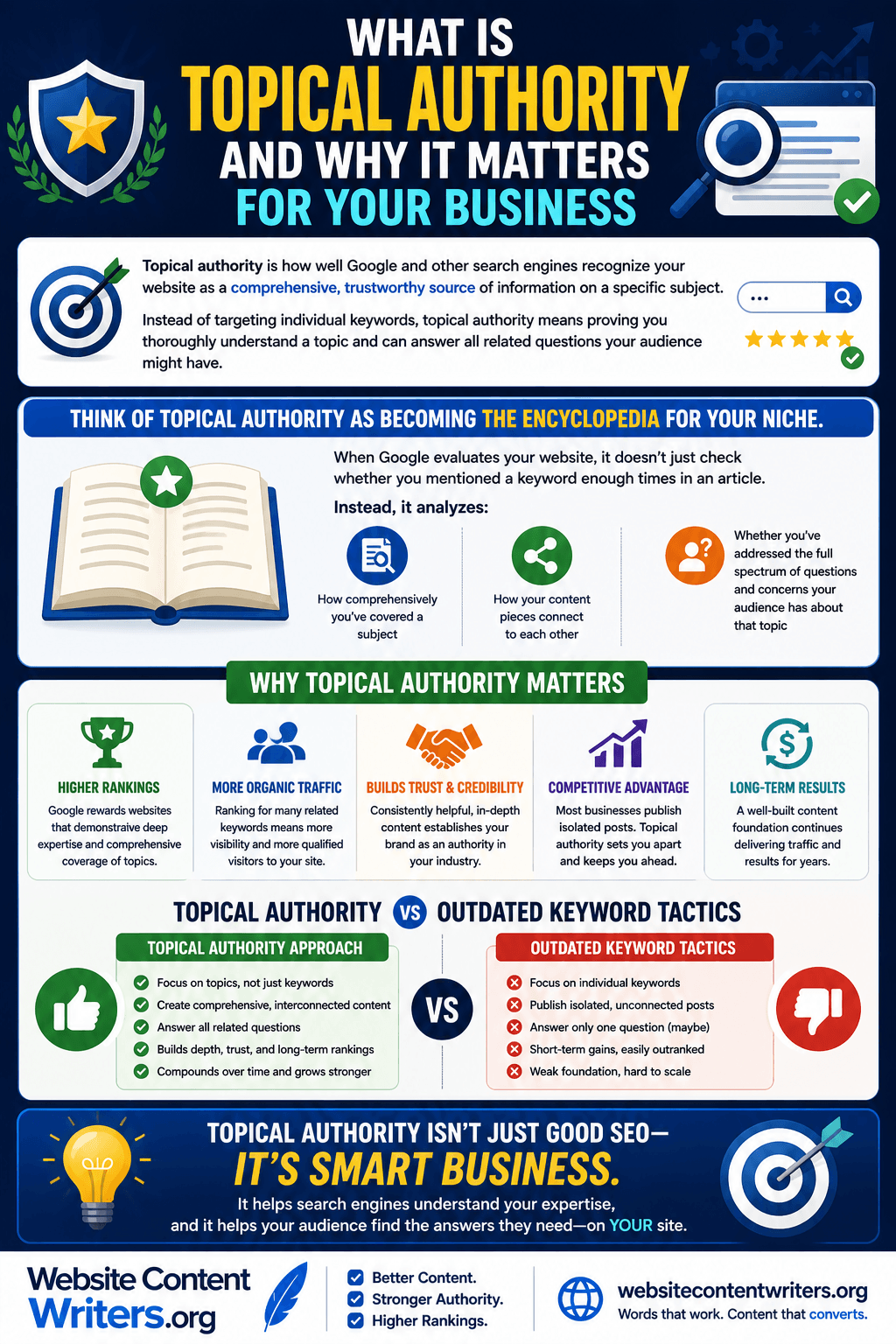
Think of topical authority as becoming the encyclopedia for your niche. When Google evaluates your website, it doesn’t just check whether you mentioned a keyword enough times in an article. Instead, it analyzes how comprehensively you’ve covered a subject, how your content pieces connect to each other, and whether you’ve addressed the full spectrum of questions and concerns your audience has about that topic.
The Evolution From Keyword-Based to Topic-Based SEO
The journey of how to build topical authority begins with understanding why Google made this significant shift. In the early days of SEO, success was relatively simple: identify a high-volume keyword, optimize your content around it, and build a few backlinks. This keyword-first approach dominated SEO strategies for years. However, several major algorithm updates have fundamentally changed how Google evaluates content quality and relevance.
The Hummingbird update in 2013 began Google’s shift toward understanding topics and semantic relationships rather than just matching keywords. RankBrain in 2015 introduced artificial intelligence to better understand search intent. BERT in 2019 brought deep natural language processing that could understand context and nuance. Most significantly for understanding how to build topical authority, the Helpful Content updates that began in 2022 and continued through 2024 explicitly reward websites that demonstrate genuine expertise and provide truly useful information.
The February 2026 Core Update reinforced this trend with unprecedented clarity. According to analysis from multiple SEO agencies, this update specifically rewarded sites with clear topical depth while cracking down on thin, low-value content that merely existed to target keywords. This progression tells a clear story: Google gets better every year at distinguishing between websites that genuinely understand a topic and those simply trying to game the system with keyword optimization.
Why Small Businesses Can Win With Topical Authority
For small business owners, learning how to build topical authority represents a significant competitive advantage. Unlike domain authority, which primarily depends on factors like your website’s age and the number of backlinks you’ve accumulated over time, learning how to build topical authority, and then implementing it, is something you have complete control over. You can start building it today, regardless of how new your website is or how limited your marketing budget might be.
The playing field has leveled in ways that benefit smaller, focused businesses. A small website that publishes twenty thoroughly researched, interconnected articles about email marketing automation can outrank a massive corporate site that has thousands of articles spread across dozens of unrelated topics. Why? Because Google recognizes the smaller site as the more authoritative source specifically for email marketing automation.
Recent data from search engine optimization experts shows that when you successfully build topical authority, your website experiences faster indexing for new content, more stable rankings during algorithm updates, better visibility in AI-powered search results, and significantly higher click-through rates from search engine results pages. These benefits compound over time, creating sustainable organic growth that doesn’t depend on paid advertising or constant link building campaigns.
The Three Foundational Pillars of How to Build Topical Authority
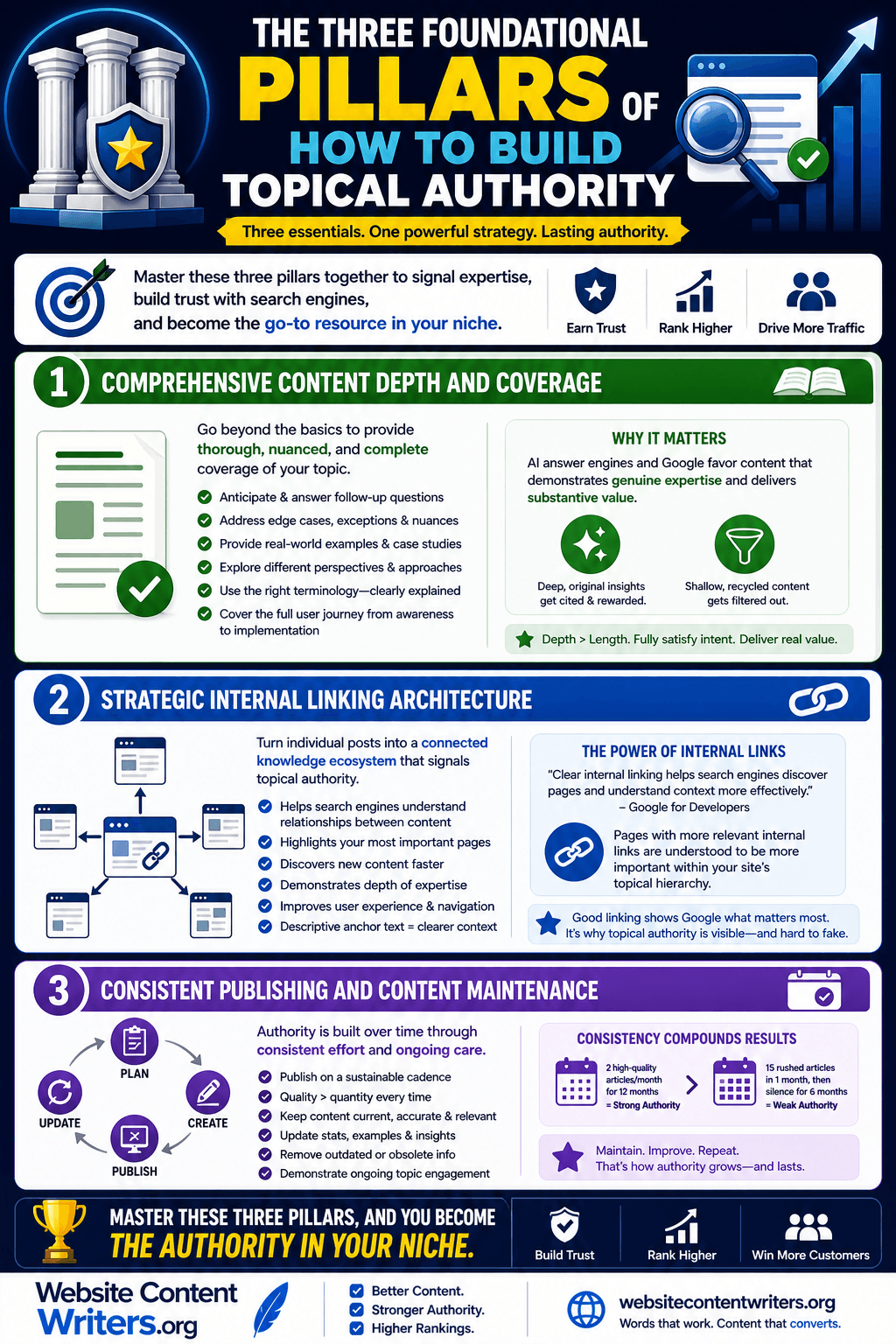
Understanding how to build topical authority requires mastering three fundamental pillars that work together to signal expertise to search engines. These pillars form the foundation of any successful topical authority strategy and must all be implemented for optimal results.
Pillar One: Comprehensive Content Depth and Coverage
The first essential element in learning how to build topical authority is creating content with genuine depth and comprehensive coverage. Content depth means going beyond surface-level explanations to provide thorough, nuanced coverage of your topic. When you create content with real depth, you anticipate and answer follow-up questions, address edge cases and exceptions, provide practical examples and case studies, and explore different perspectives and approaches to the subject.
This isn’t about making every article ten thousand words long just for the sake of length. Instead, it’s about ensuring that each piece of content fully satisfies the user’s intent and leaves them with a complete understanding of that specific aspect of your topic. Deep content includes real-world examples that demonstrate practical application, uses correct terminology while explaining concepts clearly enough that your target audience can understand, and addresses the complete user journey from initial awareness questions to detailed implementation guidance.
The shift toward AI-powered search in 2026 has made content depth even more critical. When AI answer engines like Google’s AI Overviews select sources to cite, they favor content that demonstrates genuine expertise and provides substantive value. Shallow content that simply recycles information from other sources without adding unique insights or practical value is increasingly filtered out of top search results, making depth a non-negotiable requirement for anyone learning how to build topical authority.
Pillar Two: Strategic Internal Linking Architecture
Internal linking is how you transform a collection of individual blog posts into a cohesive knowledge ecosystem that signals topical authority. When implemented correctly as part of your strategy for how to build topical authority, internal links help search engines understand the relationships between your content pieces, identify which topics are most important on your site, discover new content more quickly, and recognize the depth of your expertise on specific subjects.
Equally important, strategic internal linking improves user experience by helping visitors navigate to related information and find answers to their questions more efficiently. The architecture of your internal linking structure tells Google which pages represent your most important content. Pages with more internal links pointing to them are understood to be more significant within your website’s topical hierarchy.
Google has been explicit about the importance of crawlable links and descriptive anchor text. According to Google for Developers documentation, clear internal linking helps search engines discover pages and understand context more effectively. This practical reality is why topical authority is difficult to fake—it becomes visible in how your site is built and interconnected at a structural level, making internal linking a cornerstone of how to build topical authority successfully.
Pillar Three: Consistent Publishing and Content Maintenance
The third critical element of how to build topical authority is consistency over time. Building topical authority is not a one-time project—it requires sustained effort and ongoing commitment. Search engines track how regularly you publish new content in your area of focus and whether you maintain and update existing content to keep it current and accurate. Websites that demonstrate ongoing commitment to a topic earn stronger authority signals than those that publish sporadically or abandon topics after initial coverage.
Consistency doesn’t mean you need to publish daily or even weekly to successfully build topical authority. What matters more is establishing a sustainable publishing cadence that you can maintain long-term while ensuring quality remains high. A website that publishes two thoroughly researched, comprehensive articles per month for twelve consecutive months will build more topical authority than one that publishes fifteen rushed articles in one month and then goes silent for six months.
Content maintenance is equally important as new content creation when learning how to build topical authority. Outdated information signals to search engines that you’re not currently engaged with your topic. Regularly auditing your existing content to update statistics, refresh examples, add new insights based on industry developments, and remove obsolete information demonstrates that you’re actively maintaining your expertise. This ongoing maintenance strengthens your topical authority signals and can quickly improve rankings for existing pages.
Understanding the Topic Cluster Model: The Framework for How to Build Topical Authority
The topic cluster model is the strategic framework that makes learning how to build topical authority practical and achievable. This organizational structure helps you create content systematically while ensuring every piece contributes to demonstrating your expertise. Understanding this model is essential for small business owners who need to maximize the impact of their limited content creation resources.
What Is a Topic Cluster?
A topic cluster consists of three interconnected components that work together when you build topical authority. At the center of each cluster sits one comprehensive pillar page that provides broad coverage of the main topic. Surrounding this pillar page are multiple supporting cluster pages, each diving deep into specific subtopics or answering particular questions related to the main theme. These components are connected through strategic internal links that create a hub-and-spoke structure.
The pillar page serves as the authoritative guide for your main topic. It typically ranges from three thousand to seven thousand words and covers all major aspects of the subject at a high level. The pillar page links out to every cluster page, providing readers and search engines with a roadmap to your complete coverage of the topic. This comprehensive coverage is fundamental to how to build topical authority effectively.
Cluster pages are more focused articles that explore specific aspects of your topic in detail. Each cluster page typically ranges from one thousand to two thousand five hundred words and targets long-tail keywords related to specific questions or subtopics. These pages link back to the pillar page and may also link to other relevant cluster pages when appropriate, creating an interconnected web of content that demonstrates comprehensive topical coverage—a key requirement for anyone learning how to build topical authority.
How to Create Long-Tail Content Clusters (Step-by-Step)
Long-tail content clusters are created by grouping related low-competition keywords around a central topic, then organizing them into a pillar page and supporting articles that are internally linked. This structure helps search engines understand your expertise and allows your content to rank faster.
Implementing all you have learnt about how to build topical authority isn’t just about publishing random blog posts — it’s about creating a structured system of content. The most effective way to do this is by organizing long-tail keywords into content clusters that work together to rank.
Long-tail keywords — highly specific search queries — make up the majority of search traffic and often convert better because they reflect clear intent . When you group these keywords into clusters instead of targeting them individually, you create a powerful SEO structure that signals expertise and helps your content rank faster.
Here’s exactly how to do it:
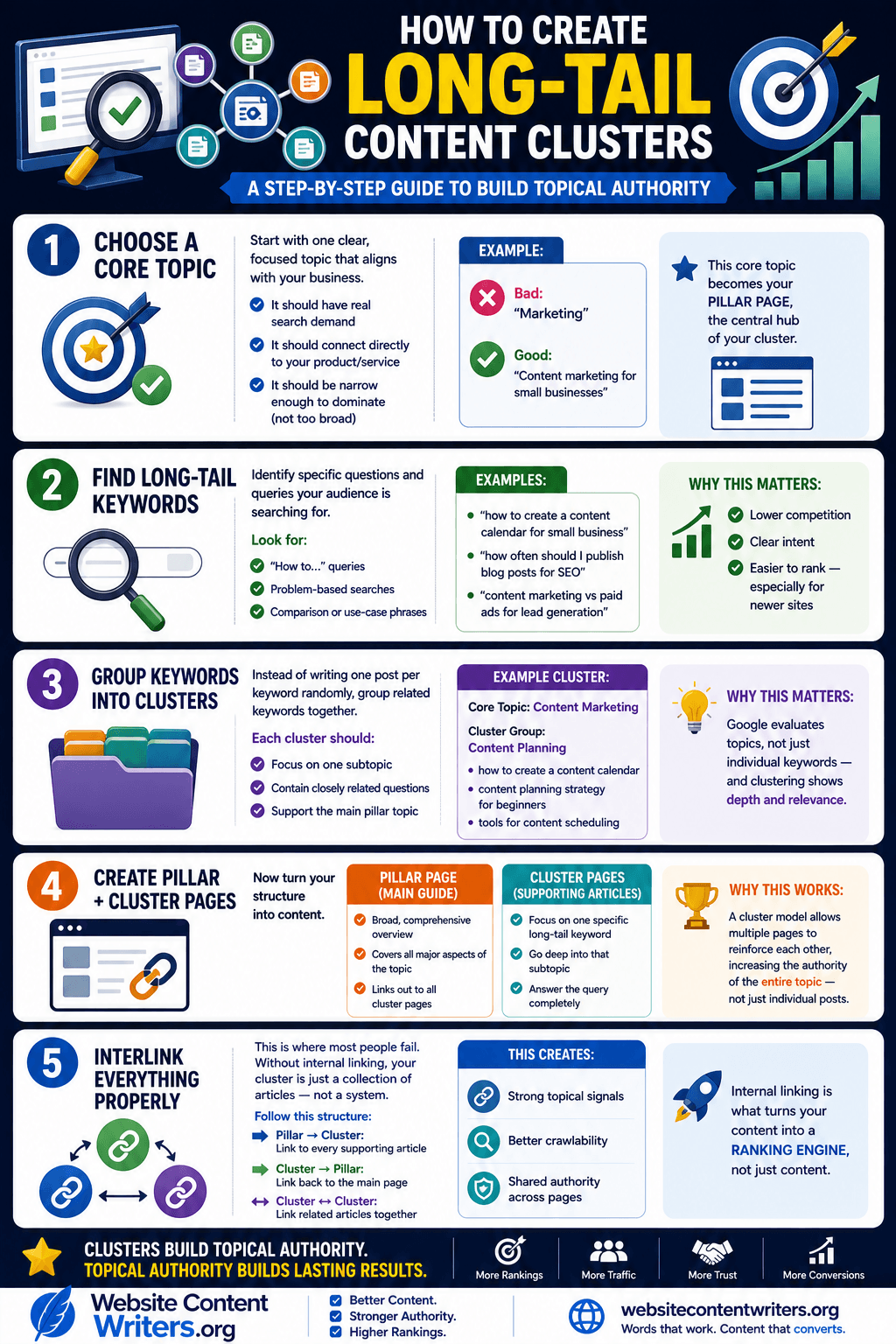
Step 1: Choose a Core Topic
Start with one clear, focused topic that aligns with your business.
-
-
-
- It should have real search demand
- It should connect directly to your product/service
- It should be narrow enough to dominate (not too broad)
-
-
Example:
-
-
-
- Bad: “Marketing”
- Good: “Content marketing for small businesses”
-
-
This core topic becomes your pillar page, which acts as the central hub of your cluster.
Step 2: Find Long-Tail Keywords
Next, identify specific questions and queries your audience is searching for. A simple method is to type your topic into Google and collect autocomplete suggestions, then expand using “People Also Ask” questions and related searches at the bottom of the page. These are real queries your audience is actively searching for.
Look for:
-
-
-
- “How to…” queries
- Problem-based searches
- Comparison or use-case phrases
-
-
Examples:
-
-
-
- “how to create a content calendar for small business”
- “how often should I publish blog posts for SEO”
- “content marketing vs paid ads for lead generation”
-
-
Why this matters:
-
-
-
- Long-tail keywords are lower competition
- They reflect clear intent
- They are easier to rank — especially for newer sites
-
-
Step 3: Group Keywords Into Clusters
Instead of writing one post per keyword randomly, group related keywords together.
Each cluster should:
-
-
-
- Focus on one subtopic
- Contain closely related questions
- Support the main pillar topic
-
-
Example of content cluster:
Core Topic: Content Marketing
Cluster Group: Content Planning
-
-
-
- how to create a content calendar
- content planning strategy for beginners
- tools for content scheduling
-
-
This grouping is critical because Google evaluates topics, not just individual keywords — and clustering shows depth and relevance .
Step 4: Create Pillar + Cluster Pages
An important lesson in learning about how to build topical authority is knowing that the more tightly connected your cluster is, the stronger your topical authority signal becomes. Pages that are isolated or weakly linked often fail to rank — even if the content is good.
Now turn your structure into content:
Pillar Page (Main Guide)
-
-
-
- Broad, comprehensive overview
- Covers all major aspects of the topic
- Links out to all cluster pages
-
-
Cluster Pages (Supporting Articles)
-
-
-
- Focus on one specific long-tail keyword
- Go deep into that subtopic
- Answer the query completely
-
-
Why this works:
A cluster model allows multiple pages to reinforce each other, increasing the authority of the entire topic — not just individual posts .
Step 5: Interlink Everything Properly
This is where most people fail. Most websites publish cluster articles but forget to link them properly. Without internal linking, Google sees them as separate pages — not a unified topic.
Without internal linking, your cluster is just a collection of articles — not a system.
Follow this structure:
-
-
-
- Pillar → Cluster: Link to every supporting article
- Cluster → Pillar: Link back to the main page
- Cluster ↔ Cluster: Link related articles together
-
-
This creates:
-
-
-
- Strong topical signals
- Better crawlability
- Shared authority across pages
-
-
Internal linking is what turns your content into a ranking engine, not just content .
Real-World Example of How to Build Topical Authority With Topic Clusters
To illustrate how the topic cluster model works in practice when you learn how to build topical authority, consider a digital marketing agency that wants to establish expertise around content marketing. Their strategy for how to build topical authority might look like this:
The pillar page would be a comprehensive guide titled “Content Marketing Strategy: Complete Guide for Small Businesses.” This page would cover the fundamentals of content marketing, explain why it matters for business growth, outline the key components of a successful strategy, provide an overview of different content types and distribution channels, and serve as the central hub for all related content.
Supporting cluster pages would dive deep into specific aspects of content marketing to build topical authority. These might include detailed articles on topics such as how to create an editorial calendar that drives consistent results, content writing best practices for blog posts that rank, optimizing content for search engines and user engagement, creating engaging video content for social media platforms, measuring content marketing ROI and analytics effectively, repurposing content across multiple channels to maximize reach, building an email list through strategic content marketing, and developing a content distribution strategy that amplifies your message.
Each cluster page would link back to the main pillar page using descriptive anchor text like “comprehensive content marketing guide” or “content marketing strategy for small businesses.” The pillar page would link to each cluster page in relevant sections throughout the content. For example, when discussing content distribution, the pillar page would link to the cluster article about repurposing content across channels. This interconnected structure is exactly how to build topical authority that Google recognizes and rewards.
Step-by-Step Guide: How to Build Topical Authority for Your Website
Now that you understand the concept of topical authority and the topic cluster model, let’s walk through the practical steps you need to take when learning how to build topical authority for your website. This systematic approach will help you create a sustainable content strategy that establishes your business as an expert in your field.
Step One: Conduct a Comprehensive Content Audit
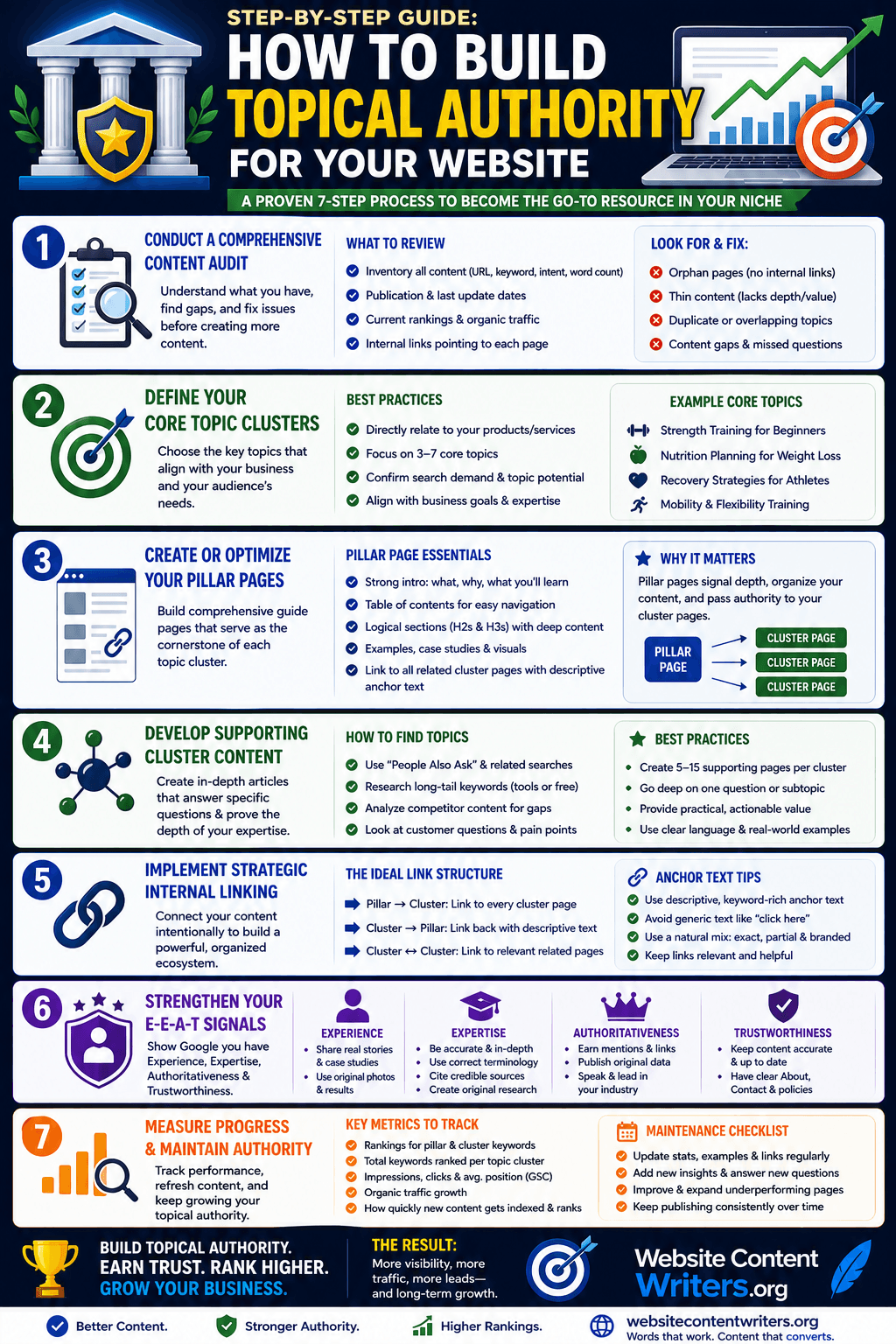
The first step in how to build topical authority is understanding what content you already have. A thorough content audit reveals your existing strengths, identifies gaps in your coverage, and helps you avoid duplicating effort. This foundational step is often skipped, but it’s critical for building topical authority efficiently.
Start by creating a complete inventory of all your existing content. Use a spreadsheet to track each piece of content along with important details such as the URL and page location, target keyword and search intent, current word count and content depth, publication and last update dates, current search rankings for target keywords, organic traffic numbers from analytics, and existing internal links pointing to the page. This inventory will serve as your baseline for measuring improvement as you build topical authority.
As you review your content during this audit phase of how to build topical authority, look for several specific issues that commonly undermine authority. Orphan pages are articles with no internal links pointing to them, which search engines often ignore because they can’t easily discover them through crawling. Thin content refers to articles that lack depth or unique value, often consisting of just a few hundred words that don’t fully answer the user’s question or address their search intent. Duplicate or overlapping topics occur when you have multiple articles targeting the same keyword or covering essentially the same information, which creates confusion for search engines about which page to rank and dilutes your topical signals.
During your audit for how to build topical authority, also identify content gaps—important topics within your area of expertise that you haven’t covered yet. Look at what questions your customers frequently ask during sales conversations, what your competitors are ranking for that you’re missing, what related search queries appear in Google’s “People Also Ask” boxes for your target keywords, and what subtopics are mentioned in top-ranking content that you haven’t addressed. These gaps represent opportunities to expand your topical coverage and strengthen your authority signals.
Step Two: Define Your Core Topic Clusters
With your content audit complete, the next step in how to build topical authority is defining the core topics around which you’ll organize your content strategy. This strategic decision will guide all your content creation efforts going forward, so it’s important to choose topics that align with your business goals and audience needs.
Your core topics when learning how to build topical authority should directly relate to your products or services and represent subjects where you can genuinely claim expertise. For most small business websites, focusing on three to seven core topics is optimal. This range keeps your strategy manageable while providing enough breadth to attract diverse segments of your target audience. Having too many clusters spreads your resources too thin and dilutes your authority signals. Too few clusters limits your growth potential and may not fully represent your business’s offerings.
When selecting your core topics for how to build topical authority, consider several important factors. First, evaluate search demand using keyword research tools to ensure sufficient search volume exists for each topic area you’re considering. Second, assess your competitive positioning—can you provide unique value or perspectives that differentiate you from existing content on the topic? Third, consider your business priorities and revenue goals—which topics most directly support customer acquisition and business growth?
Each topic cluster when you build topical authority should be named using clear, descriptive language that reflects the primary keyword you’re targeting. For example, if you run a fitness coaching business, your core topics might include strength training for beginners, nutrition planning for weight loss, recovery strategies for athletes, and mobility and flexibility training. These topic names immediately communicate what each cluster covers and help you organize your content creation efforts as you build topical authority.
Step Three: Create or Optimize Your Pillar Pages
Your pillar pages are the cornerstone of your strategy for how to build topical authority. These comprehensive guides serve as the authoritative resource for each of your core topics, and they require significant effort to create properly. However, the investment pays off through improved rankings, increased organic traffic, and enhanced credibility with your audience.
A strong pillar page that effectively helps you build topical authority includes several essential components that work together. The page should begin with a compelling introduction that clearly explains what the topic is, why it matters to your audience, and what the reader will learn from the comprehensive guide. A table of contents helps readers navigate to specific sections and signals to search engines the comprehensive nature of your coverage—a critical element of how to build topical authority.
The main content should be organized into logical sections, each covering a major aspect of the topic in enough detail to provide real value. Use clear heading hierarchy with H2 tags for main sections and H3 tags for subsections to create structure that both readers and search engines can easily navigate. Within each section, provide thorough explanations, real-world examples and case studies, practical guidance that helps readers understand and apply the information, and visual elements like images, charts, or infographics that enhance understanding and engagement.
Strategic internal linking is crucial within your pillar page when learning how to build topical authority. As you discuss each major aspect of the topic, link to your relevant cluster pages where readers can dive deeper into that specific subtopic. Use descriptive anchor text that clearly indicates what the linked page covers and includes relevant keywords naturally. These links serve multiple purposes in how to build topical authority: they help readers find related information easily, signal to search engines how your content is organized and interconnected, and distribute authority throughout your topic cluster to strengthen overall topical signals.
Step Four: Develop Supporting Cluster Content
With your pillar pages established, the next step in how to build topical authority is creating the supporting cluster content that proves the depth of your expertise. Each cluster page should focus on a specific question, problem, or subtopic related to your pillar page. This focused approach allows you to provide more detailed, practical information than you could include in the pillar page itself while building topical authority through comprehensive coverage.
To identify the right topics for your cluster pages when learning how to build topical authority, use several research methods. Start by analyzing the “People Also Ask” boxes and related searches that appear when you search for your pillar page keywords—these represent real questions your audience is asking. Use keyword research tools like Semrush, Ahrefs, or free options like Google Keyword Planner to find long-tail keywords related to your main topic that have decent search volume but lower competition. Review competitor websites to see what subtopics they’ve covered that you might be missing in your strategy to build topical authority.
Each topic cluster should contain between five and fifteen supporting pages to demonstrate comprehensive coverage as you build topical authority. The exact number depends on the breadth of your topic and how many distinct questions or subtopics exist within that subject area. Quality matters far more than quantity when learning how to build topical authority—ten thoroughly researched, genuinely helpful cluster pages will build more authority than twenty shallow articles that barely scratch the surface of their subjects.
When creating cluster content to build topical authority, maintain consistent quality and depth across all pieces. Each article should fully answer the question or address the problem it’s targeting, include practical examples and real-world applications, provide step-by-step instructions where appropriate, and offer actionable advice readers can implement immediately. Use clear, accessible language that your target audience can understand even when explaining complex topics, remembering that you’re writing for small business owners who may not have technical expertise in your field.
Step Five: Implement Strategic Internal Linking
Internal linking transforms your collection of individual articles into a cohesive ecosystem when you build topical authority. While you should include basic internal links as you create content, a dedicated internal linking audit and optimization pass ensures you’re maximizing the authority-building potential of your content structure.
The ideal internal linking structure for how to build topical authority follows a clear pattern. Your pillar page should link to every cluster page in the topic, creating clear pathways for both users and search engines to discover all related content. Each cluster page should link back to the pillar page using descriptive anchor text, creating the hub-and-spoke structure that signals topical organization. Cluster pages should link to other relevant cluster pages when contextually appropriate, but these lateral links should be selective and natural rather than forced.
Anchor text selection is crucial for effective internal linking when you build topical authority. Use descriptive anchor text that clearly indicates what the linked page is about and includes relevant keywords naturally. Avoid generic phrases like “click here” or “read more,” which provide no context to users or search engines about the destination page. However, also avoid over-optimizing with exact match keywords in every link, which can appear manipulative. A mix of exact match, partial match, and branded anchor text creates the most natural linking profile as you build topical authority.
Step Six: Strengthen Your E-E-A-T Signals
In 2026, Google’s E-E-A-T framework—Experience, Expertise, Authoritativeness, and Trustworthiness—plays a critical role in how search engines evaluate your efforts to build topical authority. Building strong E-E-A-T signals requires going beyond just creating good content to demonstrating credibility and building trust with both users and search engines.
Experience signals show that your content when you build topical authority is based on real-world knowledge rather than just theoretical understanding. Include personal anecdotes and case studies that demonstrate you’ve actually done what you’re teaching your audience. Use original photos, screenshots, or videos that show your direct involvement with the subject matter. Share specific results, metrics, or lessons learned from your own implementation of the strategies you’re teaching. This firsthand experience is particularly valuable in 2026 as it’s difficult for AI-generated content to replicate convincingly, making it a powerful differentiator as you build topical authority.
Expertise is demonstrated through the depth and accuracy of your content when you build topical authority. Use correct technical terminology while explaining concepts clearly for your target audience. Cite credible sources when making claims or sharing data to back up your points. Provide comprehensive coverage that addresses not just basic questions but also nuanced aspects and edge cases that demonstrate deep knowledge. Create long-form guides, whitepapers, or original research that explores topics thoroughly and provides unique value that can’t be found elsewhere.
Authoritativeness when learning how to build topical authority comes from being recognized as a leader in your field. Publish original research or proprietary data that others can reference and cite in their own content. Speak at industry events or participate in expert panels to build recognition. Build a strong personal or company brand that becomes associated with your topic in people’s minds. Earn mentions and links from other authoritative websites in your industry through the quality of your content and thought leadership.
Step Seven: Measure Progress and Maintain Your Authority
The final step in how to build topical authority is measuring your progress and maintaining the authority you’ve built. Building topical authority is not a one-time project but an ongoing commitment that requires regular monitoring and continuous improvement.
Monitor your keyword rankings for both your pillar pages and cluster pages as you build topical authority. Track how many total keywords you rank for related to each topic cluster over time. Strong topical authority often manifests as ranking for keywords you didn’t explicitly target, as Google recognizes your comprehensive coverage of the topic and shows your content for related queries. Use Google Search Console to track impressions, clicks, and average position for queries related to your core topics.
Observe how quickly new content gets indexed and starts ranking as you build topical authority. As your topical authority strengthens over time, you should notice that new cluster pages get discovered faster by search engines and achieve rankings more quickly than they did when you first started building the cluster. This acceleration is a clear signal that Google recognizes you as an authority in the topic and trusts your new content.
Common Mistakes to Avoid When Learning How to Build Topical Authority
Understanding what not to do is just as important as knowing the right strategies for how to build topical authority. Many website owners make predictable mistakes that undermine their authority-building efforts and waste valuable time and resources.
One of the most common mistakes when learning how to build topical authority is spreading your focus too thin across too many topics. Trying to be an authority on everything means you become an authority on nothing. If you attempt to build topical authority on twenty different subjects simultaneously, you’ll lack the resources to create truly comprehensive coverage for any of them. Instead, focus on two to five core topics maximum and build deep expertise in those areas before expanding to additional subjects.
Another frequent error is prioritizing volume over value when trying to build topical authority. Publishing fifty thin, shallow articles does not build topical authority as effectively as creating twenty comprehensive, deeply researched pieces. Search engines in 2026 are sophisticated enough to distinguish between content that genuinely helps users and content created primarily to fill space or target keywords. Every piece of content you publish should provide substantial value and fully address its topic to effectively build topical authority.
Neglecting internal linking is a critical mistake that prevents many websites from realizing the full potential of their efforts to build topical authority. You might have excellent individual articles, but without strategic internal links connecting them into cohesive topic clusters, search engines struggle to understand your topical expertise. Make internal linking a standard part of your content creation workflow rather than an afterthought you address months later when learning how to build topical authority.
Tools and Resources for How to Build Topical Authority
While learning how to build topical authority doesn’t require expensive tools, certain resources can make the process more efficient and data-driven. These tools help you research topics, identify content gaps, optimize your content structure, and measure your progress as you build topical authority.
For keyword research and topic discovery when you build topical authority, tools like Google Keyword Planner provide free insights into search volume and related keywords. Google Search Console is essential for tracking your organic performance, identifying which queries you’re ranking for, and discovering new opportunities. More advanced platforms like Semrush, Ahrefs, or Moz offer comprehensive topic research features, competitor analysis capabilities, and keyword clustering that can help you identify gaps in your topical coverage.
Content optimization tools can help ensure your articles meet quality standards when you build topical authority. Yoast SEO is a popular WordPress plugin that provides real-time feedback on keyword usage, readability, and technical optimization. Clearscope and SurferSEO analyze top-ranking content for your target keywords and provide recommendations for improving topical coverage and semantic relevance.
Internal linking analysis tools help you identify opportunities to strengthen your topic clusters as you build topical authority. Screaming Frog SEO Spider can crawl your website and map out your internal linking structure, identifying orphan pages and weak link opportunities. Link Whisper is a WordPress plugin that suggests relevant internal linking opportunities as you write, making it easier to build strong topical connections.
For those specifically focused on how to build topical authority, Topical Clusters offers specialized tools designed specifically for this purpose. The platform analyzes your existing content and organizes it into meaningful topical groups, discovers internal linking opportunities you may have missed, identifies content gaps in your topic coverage, and provides actionable insights to improve your topical authority. This focused approach makes it easier for small business owners to implement effective topic cluster strategies without needing deep SEO expertise.
Conclusion: Your Path to Successfully Build Topical Authority
Learning how to build topical authority has emerged as the most effective SEO strategy for small businesses in 2026. Unlike traditional approaches that focused on isolated keywords and aggressive link building, topical authority allows you to compete based on genuine expertise and comprehensive content coverage. This levels the playing field, enabling focused small businesses to outrank larger competitors who spread themselves too thin across multiple unrelated topics.
The process of how to build topical authority follows a clear, systematic path that any business owner can implement. Start by auditing your existing content to understand your current strengths and gaps. Define three to seven core topics that align with your business goals and audience needs. Create comprehensive pillar pages that serve as authoritative guides for each topic. Develop supporting cluster content that demonstrates the depth of your expertise. Implement strategic internal linking to connect your content into cohesive topical ecosystems. Strengthen your E-E-A-T signals to build trust and credibility. Finally, measure your progress and maintain your authority through regular updates and continued content development.
The benefits of successfully learning how to build topical authority extend far beyond improved search rankings. Websites with strong topical authority experience faster indexing for new content, more stable rankings during algorithm updates, better visibility in AI-powered search results, higher user engagement and time on site, improved conversion rates from organic traffic, and reduced dependence on paid advertising. These advantages compound over time, creating sustainable organic growth that supports long-term business success.
Remember that how to build topical authority is a marathon, not a sprint. You likely won’t see dramatic results in the first month or even the first quarter. However, websites that commit to this strategy and maintain consistency for six to twelve months typically see significant improvements in their organic visibility and traffic. The authority you build becomes increasingly difficult for competitors to displace, creating a defensible competitive advantage for your business.
Start today with small, manageable steps in how to build topical authority. Choose one core topic where you can genuinely claim expertise. Audit your existing content related to that topic. Create or optimize a pillar page that provides comprehensive coverage. Then systematically develop supporting cluster content that demonstrates the depth of your knowledge. Focus on creating genuinely helpful content that addresses your audience’s real questions and needs. The rankings and traffic will follow as you consistently build topical authority over time.
Frequently Asked Questions About How to Build Topical Authority
Here are three FAQs on the topic of “How to Build Topical Authority“:
Building meaningful topical authority typically requires six to twelve months of consistent effort for most websites. The exact timeline for how to build topical authority depends on several factors including your current domain authority and site age, the competitiveness of your chosen topics and the strength of existing competitors, the quality and depth of your content compared to what’s already ranking, how consistently you publish and maintain your content over time, and the strength of your internal linking structure and overall site architecture.
New websites should expect to be on the longer end of this timeframe when learning how to build topical authority since they lack the baseline trust that established domains enjoy. During the first three months, you’ll primarily be laying the foundation by creating pillar pages and initial cluster content. You may see some early wins for long-tail keywords with lower competition, but significant ranking improvements for competitive terms usually don’t appear until months four through six of your efforts to build topical authority.
By months seven through twelve of your journey to build topical authority, if you’ve maintained consistency and quality, you should notice accelerating results including faster indexing of new content by Google, rankings for keywords you didn’t explicitly target in your content, steadily increasing organic traffic to your topic cluster pages, and improved user engagement metrics like time on page and pages per session. It’s important to understand that topical authority accumulates over time rather than appearing suddenly.
Each piece of quality content you add strengthens the authority signal for your entire topic cluster when you build topical authority. The compound effect means that your twentieth article in a topic will likely rank faster and perform better than your fifth article did, because Google increasingly recognizes you as an authority on that topic. This compounding makes it worth staying committed to learning how to build topical authority even when early results seem modest. The good news is that once you’ve built topical authority, it becomes easier to maintain and expand, making the initial investment worthwhile.
There is no magic number of articles that automatically grants topical authority when learning how to build topical authority, as it depends more on comprehensive coverage than sheer volume. However, most successful topic clusters contain between eight and twenty pieces of content, including one pillar page and seven to nineteen supporting cluster pages. The specific number you need to build topical authority depends on the breadth of your topic and how many distinct questions or subtopics exist within that subject area.
The key to how to build topical authority is complete topic coverage rather than hitting a specific article count. Your content should address all the major questions someone might have about your topic, from basic definitions and foundational concepts to advanced implementation strategies and troubleshooting common problems. Use tools like Google’s People Also Ask feature, keyword research platforms, and competitor analysis to identify the full scope of subtopics you need to cover when you build topical authority.
Quality matters significantly more than quantity when learning how to build topical authority. Ten thoroughly researched, comprehensive articles of one thousand five hundred to two thousand five hundred words each will build more authority than thirty shallow three hundred word posts that provide minimal value. Each piece of content should fully address its specific topic, provide unique insights or perspectives that differentiate it from existing content, include practical examples and actionable advice readers can implement, and satisfy the user’s search intent completely.
Start with a core set of eight to twelve well-planned articles covering the most important aspects of your topic when you build topical authority. This foundation demonstrates basic topical coverage to search engines. Then expand strategically based on keyword research results, customer questions you receive through sales and support, content gap analysis showing what competitors cover that you don’t, and emerging trends or developments in your industry. Continuously adding high-quality content to your topic clusters signals to Google that you’re actively maintaining your expertise and staying current in your field—a critical factor in how to build topical authority successfully.
Yes, understanding how to build topical authority is one of the few SEO strategies where small businesses can effectively compete with and even outrank much larger competitors. This is because Google evaluates topical authority based on depth and focus rather than overall domain size or age. A small business website with twenty deeply researched, interconnected articles about a specific niche topic can demonstrate stronger topical authority than a massive corporate site with thousands of articles spread across dozens of unrelated subjects.
The key advantage for small businesses learning how to build topical authority is the ability to be laser-focused on specific topics where you have genuine expertise. Large websites often struggle with topical dilution—their content library covers so many different subjects that they don’t achieve deep authority in any single area. Meanwhile, your small business can become the definitive resource for your chosen niche by dedicating all your content creation efforts to comprehensive coverage of that specific topic when you build topical authority.
Research from digital marketing agencies shows that sites with focused topical authority often outrank generalist publishers that spread thin across dozens of categories. Google’s February 2026 Core Update specifically emphasized rewarding sites with deep expertise in focused subject areas over those covering everything superficially. This algorithmic shift creates opportunities for smaller, specialized businesses to capture meaningful organic traffic in their niches by mastering how to build topical authority.
To maximize your competitive advantage as a small business learning how to build topical authority, choose topics that are specific enough to dominate but broad enough to drive meaningful traffic. Focus on three to five core topics maximum rather than trying to compete across your entire industry. Create content that demonstrates firsthand experience and practical expertise that larger competitors can’t easily replicate because they lack your specialized knowledge. Build relationships within your niche to earn authoritative backlinks and brand mentions that reinforce your expertise. Most importantly, maintain consistency and commit to the long-term process of how to build topical authority rather than looking for quick wins that rarely materialize.
The playing field is more level than ever before when it comes to learning how to build topical authority. Small businesses that execute this strategy well can capture significant market share in their target niches, even when competing against industry giants with vastly larger marketing budgets and higher domain authority. Your expertise and focus when you build topical authority become your competitive advantages that larger competitors struggle to match.
This approach aligns with how modern search engines evaluate content — by topic coverage, semantic relationships, and internal structure rather than isolated keywords.