


If you have been running a small business website for any length of time, you already know that staying visible online is a moving target. Just when you figure out one approach, the rules change. And right now, if you want to learn about building topical authority for AI, you already know the rules are changing faster than ever.
The rise of AI-powered search tools — ChatGPT, Google’s AI Overviews, Perplexity, Gemini — has fundamentally shifted how your potential customers discover information, find solutions, and decide which businesses to trust. These platforms do not show users a list of results and let them choose. They generate a single, confident answer. And somewhere in that answer, an AI system has already decided which sources are credible enough to draw from. The question is whether your website is one of them.
This is exactly why building topical authority for AI has become the defining content strategy for small business owners in 2026. It is not about gaming an algorithm or chasing the latest SEO trend. It is about structuring your website so that it genuinely looks — and is — the most comprehensive, trustworthy resource on your specific topic. Whether you are completely new to this concept or you have heard the term and are not sure where to start, this guide will walk you through everything you need to know, in plain language, step by step.
Building Topical Authority for AI: Introduction
If you have been running a small business website for any length of time, you have probably noticed that the way people search for information is changing rapidly. Not long ago, the goal was straightforward: write a well-optimized blog post, earn a few backlinks, and climb the rankings on Google. That model worked for years. But if you are still relying on it exclusively in 2026, you are optimizing for a search landscape that no longer exists in its original form.
The rise of AI-powered search tools has fundamentally changed how your potential customers find information online. Platforms such as ChatGPT, Google’s AI Overviews, Perplexity, and Gemini are no longer just novelties. They have become the primary research tools for millions of people every single day. Instead of clicking through ten search results to find an answer, users now ask a question in plain language and receive a direct, synthesized response, often without visiting a single website. And somewhere in that response, an AI system has decided which sources to trust and cite. The question is: will your website be one of them?
This is precisely why building topical authority for AI has become one of the most important SEO strategies a small business owner can invest in right now. Understanding what this means, how it works, and how to apply it practically — without needing a degree in computer science or a team of SEO consultants — is what this guide is all about. By the time you reach the end of this article, you will have a clear, actionable framework for transforming your website into the kind of trusted knowledge source that AI systems actively choose to reference and recommend.
Let us start at the beginning: what exactly is topical authority for AI, and why does it matter so much for your business right now?
What Is Topical Authority for AI Search, and Why Has It Changed Everything?
Before diving into strategy and execution, it is worth taking a moment to understand what the phrase “building topical authority for AI” actually means. The term combines two distinct ideas that are now deeply intertwined: topical authority as an SEO concept, and AI search as the emerging dominant way people discover information online.
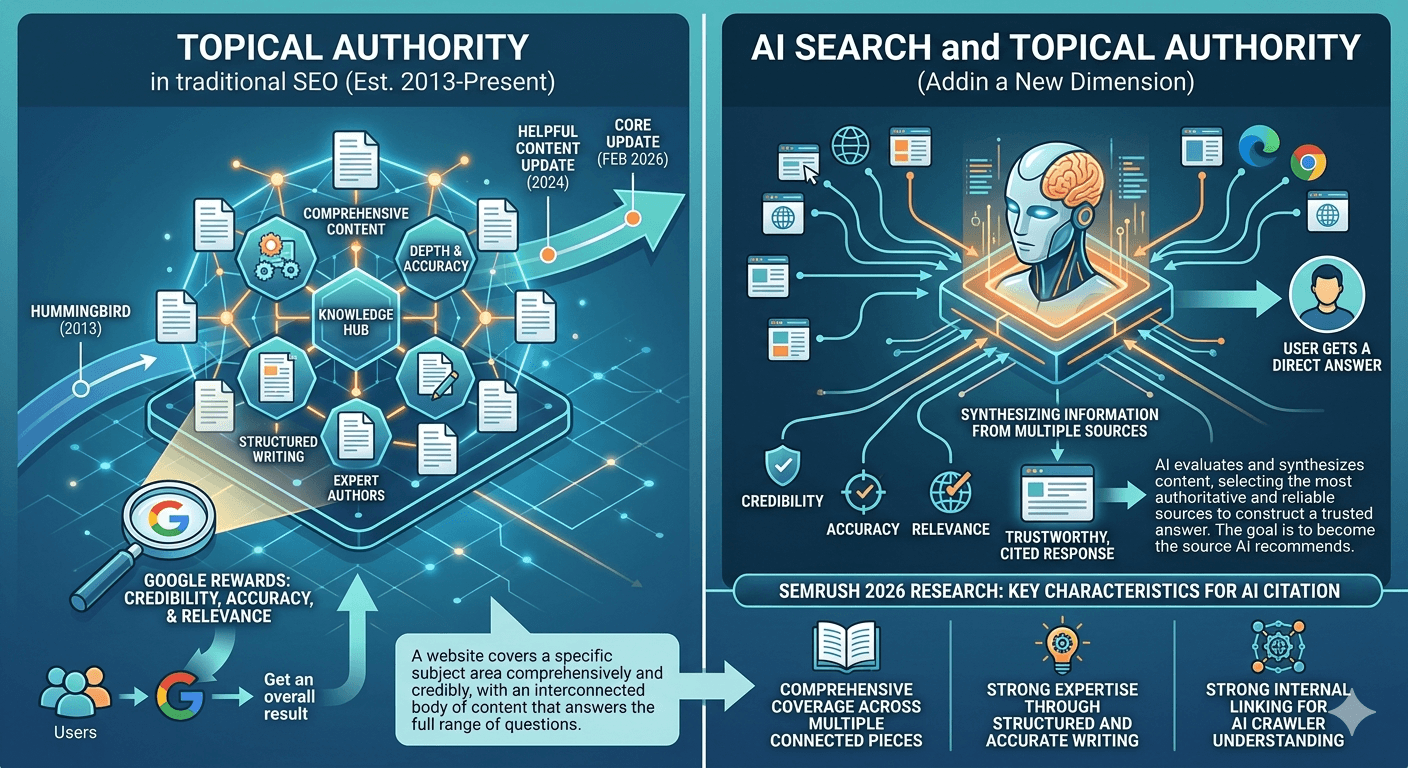
Topical authority, in its original SEO sense, refers to how comprehensively and credibly your website covers a specific subject area. A website with strong topical authority does not just have one or two articles on a topic — it has an interconnected body of content that covers the subject from multiple angles, answers the full range of questions a reader might have, and demonstrates genuine expertise through depth, accuracy, and structure. Google has been rewarding topical authority since the Hummingbird algorithm update in 2013, and that reward has only grown stronger through every subsequent update, including the 2024 Helpful Content Update and the February 2026 Core Update.
AI search adds an entirely new dimension to this concept. When an AI system such as ChatGPT or Perplexity generates a response to a user’s question, it does not simply retrieve and display the top-ranked Google result. It synthesizes information from multiple sources, evaluates those sources for credibility, accuracy, and relevance, and then constructs an answer that it presents as trustworthy. The sources it selects to reference and cite are the ones it has evaluated as authoritative on that specific subject. This is why building topical authority for AI search is not just about ranking on a results page anymore — it is about becoming the source that AI systems consider reliable enough to draw from and recommend.
According to research published by Semrush in early 2026, websites that appear in AI-generated responses share several consistent characteristics: they cover their topic comprehensively across multiple connected pieces of content, they demonstrate clear expertise through structured and accurate writing, and they have strong internal linking that helps AI crawlers understand how their pages relate to one another. None of these characteristics happen by accident. They are the direct result of a deliberate content strategy built around topical authority.
The Shift From Rankings to Citations in AI-Driven Search
One of the most important mindset shifts for small business owners to make is understanding that AI search does not operate on rankings the way traditional search does. When you optimize for Google, your goal is to appear on page one for a specific keyword. Position number one typically earns around twenty-five to thirty percent of all clicks for that query. There is a clear, measurable hierarchy, and you know exactly where you stand.
AI search is fundamentally different. AI systems do not display a ranked list of results for users to choose from. They generate a single, synthesized answer that either includes your content or does not. Your website is either cited as a source or it is invisible. This binary reality makes building topical authority for AI search not just a competitive advantage but a genuine necessity for any small business that wants to remain visible as AI-powered discovery continues to grow.
The good news — and this is genuinely good news for small businesses — is that the factors that earn citations in AI-generated responses are exactly the same factors that have always characterized excellent content: depth, accuracy, clear structure, and genuine expertise on a specific subject. You do not need to trick an algorithm. You need to build a website that genuinely knows its subject inside and out, and organizes that knowledge in a way that both human readers and AI systems can navigate easily.
Key Insight: AI systems do not rank pages. They select sources they trust. Building topical authority for AI is the process of becoming one of those trusted sources through structured, comprehensive, and interconnected content.
Topical Authority and Topical Clusters: The Framework Behind Building Topical Authority for AI
To understand how building topical authority for AI works in practice, you need to understand the two structural concepts at the heart of it: topical authority itself, and topical clusters. These two ideas work together to create the kind of content ecosystem that both search engines and AI systems recognize as genuinely authoritative.
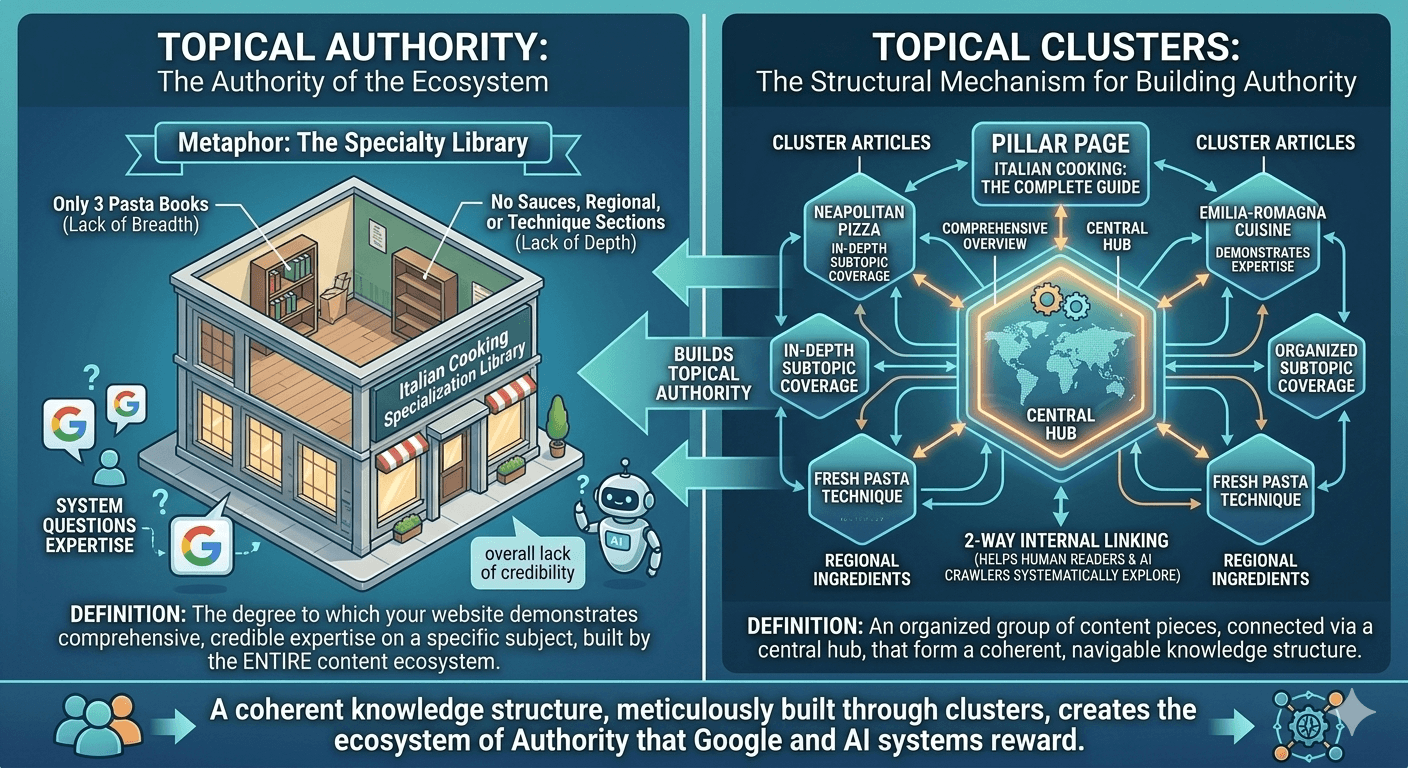
Topical authority, as we touched on in the introduction, is the degree to which your website demonstrates comprehensive, credible expertise on a specific subject. It is not just about having good individual articles. It is about the overall impression your entire content ecosystem creates. Think of it like this: if you walked into a library that claimed to specialize in Italian cooking, and you found only three books on pasta but nothing on sauces, regional cuisines, techniques, or ingredients, you would question whether that library genuinely specialized in Italian cooking at all. Google and AI systems apply the same logic to your website. A site that claims to be about content marketing but only has four loosely connected articles will not be treated as an authority, no matter how good those articles are individually.
Topical clusters are the structural mechanism that builds topical authority. A topical cluster is an organized group of content pieces, all focused on the same broad subject, that are connected to each other through a central hub article known as a pillar page. The pillar page provides a comprehensive overview of the main topic and links outward to each supporting cluster article. Every cluster article covers one specific subtopic in depth and links back to the pillar page. Together, they form a coherent, navigable knowledge structure that both human readers and AI crawlers can explore systematically.
The Anatomy of a Topical Cluster
Understanding the structure of a topical cluster is essential before you can begin building topical authority for AI search. Every cluster has three core components, and each one plays a distinct role in establishing authority. Here is how those three components work together:
- The Pillar Page: This is the central hub of the cluster — a long-form, comprehensive guide that covers the main topic broadly. It does not go deeply into every subtopic, but it addresses all of them sufficiently and links out to the cluster articles for readers who want to go deeper. A strong pillar page is typically two thousand to four thousand words and serves as the most authoritative single document on your core topic.
- Cluster Articles: These are the supporting pieces that surround the pillar page. Each one focuses on a specific subtopic related to the main theme, goes into significant depth on that subtopic, and links back to the pillar page as the central authority document. A healthy cluster typically contains between six and fifteen cluster articles, though this varies by niche and topic complexity.
- Supporting Articles: These are the most specific pieces in the cluster — highly targeted articles that answer very precise questions, address long-tail search queries, or compare specific tools, techniques, or approaches within the subtopic. They link upward to their parent cluster article and are the entry points through which many new readers discover your content.
When all three components are in place and properly interlinked, Google and AI systems see a complete, self-reinforcing knowledge structure. This structure signals something very specific: this website does not just have an opinion about this topic. It has mastered it. And that is precisely the signal that builds topical authority for AI search.
Why Topical Clusters Are Especially Powerful for AI Citations
AI search systems, including the large language models that power ChatGPT, Perplexity, and Google’s AI Overviews, are fundamentally designed to evaluate and synthesize information at a topic level rather than a page level. According to analysis from LLMrefs.com, AI models build internal representations of topics by evaluating how consistently and comprehensively a source covers a subject across multiple pieces of connected content. A site with a well-built topical cluster covering every major question in its niche registers as a high-confidence source on that topic — and high-confidence sources are the ones that get cited.
Research cited by TripleDart in their 2026 LLM SEO guide found that websites with interconnected topical clusters see citation rates in AI-generated responses that are approximately forty percent higher than websites with the same amount of content organized as disconnected individual posts. The reason is straightforward: AI systems process meaning and relationships, not just keywords. When your content demonstrates rich, interconnected relationships across a topic, you look like an expert. When it exists as isolated posts, you look like a generalist with scattered opinions.
Practical Takeaway: One complete, well-interlinked topical cluster on a specific subject will do more for building topical authority for AI than twenty disconnected blog posts spread across vaguely related topics. Completeness and connection matter more than volume.
The Five Pillars of Building Topical Authority for AI Search
Now that you understand the foundational concepts, it is time to look at the specific factors that determine whether your website gets selected as a trusted source by AI systems. Building topical authority for AI is not a single action you take once and forget. It is an ongoing practice built on five interconnected pillars, each of which reinforces the others. Understanding all five pillars is essential before you start creating or restructuring your content.
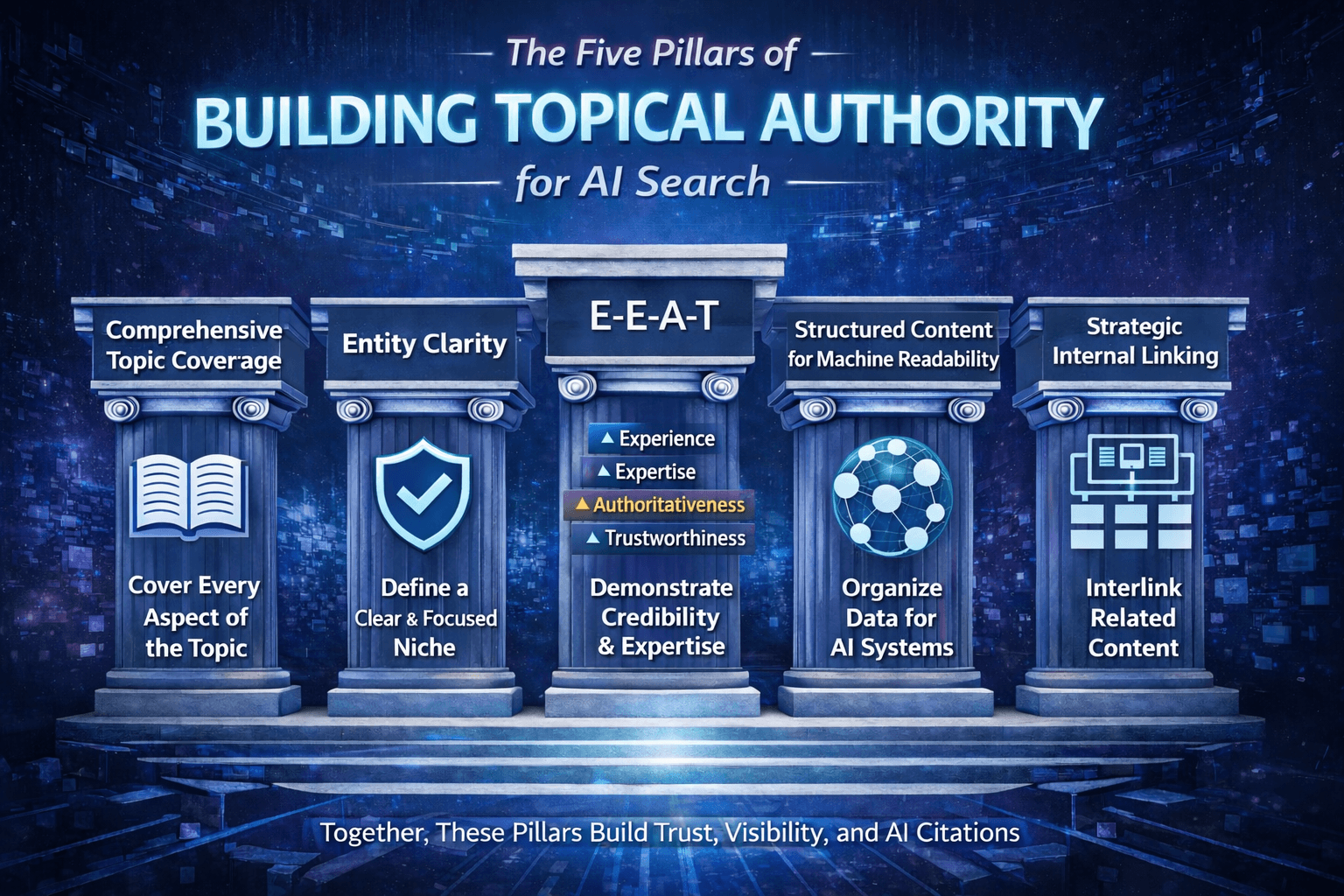
Pillar One: Comprehensive Topic Coverage
The most fundamental requirement for building topical authority for AI search is that your website must cover its chosen topic comprehensively. This means addressing not just the most popular questions about a subject, but the full range of questions — from beginner-level definitions to advanced implementation strategies, from foundational concepts to common mistakes, from overviews to specific how-to guides. AI systems evaluate sources based on how completely they cover a topic, and partial coverage is treated as a sign of limited expertise.
For a small business owner, this does not mean you need to publish hundreds of articles before your strategy starts working. What it means is that the articles you do publish should be strategically chosen to cover the key dimensions of your topic, not randomly selected based on whatever keyword has high search volume this month. Before you write a single word, you should be able to map out the main categories of questions your audience has about your topic and ensure that your publishing plan addresses all of them over time. The process of creating that map — your topical map — is covered in the next section of this guide.
The Vercel engineering blog, which is widely cited as a credible source for technical SEO practices, describes comprehensive topic coverage as the practice of becoming the first or most definitive explanation of a concept. If you can be the most thorough, accurate, and accessible treatment of your core topic on the web, AI systems will find you and return to you repeatedly as a trusted source.
Pillar Two: Entity Clarity
AI systems do not just read content — they identify entities. In the context of AI search, an entity is any clearly defined concept, brand, person, place, or thing that can be recognized and categorized. When AI systems evaluate your website, one of the key questions they are answering is: what is this site about? If the answer is clear and consistent, your site registers as a credible entity in that subject space. If the answer is muddled because your content covers too many unrelated topics, your entity profile becomes weak and your citation likelihood drops.
For small business owners, this means choosing your niche carefully and sticking to it. A website that covers content marketing one month, general business advice the next, and personal finance tips after that is not sending a clear entity signal to AI systems. But a website that consistently publishes well-researched content on a single focused topic — say, content strategy for local service businesses — builds an increasingly clear and recognized entity profile over time. That clarity is what allows AI systems to say with confidence: when a user asks about content strategy for local businesses, this source knows what it is talking about.
Pillar Three: E-E-A-T Signals
E-E-A-T stands for Experience, Expertise, Authoritativeness, and Trustworthiness. These four qualities have been part of Google’s Search Quality Evaluator Guidelines for years, but they have taken on new significance in the context of AI-driven search. AI systems are trained to prioritize sources that demonstrate genuine expertise and real-world experience — not just content that sounds authoritative on the surface, but content that shows the kind of depth and accuracy that only comes from actually knowing a subject well.
For a small business owner building topical authority for AI search, strengthening E-E-A-T signals is one of the most powerful actions you can take. There are several concrete ways to do this, and each one contributes to making your content more credible in the eyes of AI systems. The following approaches are the most effective ones to focus on:
-
- Author credibility: Include a clear author bio on every piece of content, listing relevant experience, qualifications, and expertise. AI systems evaluate authorship signals when assessing source quality.
- Original data and examples: Include real-world examples from your own experience, case studies from your business or clients, and original data wherever possible. Content written by AI and recycled from other sources does not perform well in AI citations — what AI systems want is new information and genuine firsthand perspective.
- Accurate citations: Link to credible, high-authority sources when making factual claims. This cross-referencing behavior signals to AI systems that your content is anchored in verified information rather than speculation.
- Content maintenance: Regularly update your articles to keep them accurate and current. Research from LLMrefs.com shows that AI citation rates drop sharply for content older than three months that has not been refreshed. Freshness is a direct trust signal.
Each of these E-E-A-T signals works together to create a cumulative picture of trustworthiness. No single action will make or break your AI citation potential, but together they form the foundation of a content presence that AI systems find credible and dependable.
Pillar Four: Structured Content for Machine Readability
One of the most practical and immediately actionable pillars of building topical authority for AI is structuring your content in a way that AI systems can easily parse, extract, and incorporate into their responses. Unlike human readers, who can infer meaning from conversational or loosely structured prose, AI systems work most efficiently when content follows clear, predictable structural patterns.
According to Wellows‘ comprehensive LLM SEO guide published in March 2026, pages with proper JSON-LD schema implementation can be evaluated for AI citation potential significantly faster than unstructured pages. But you do not need to be a technical developer to improve the structural readability of your content. Most of the most effective structural improvements are straightforward formatting choices that also make your content more useful for human readers. The key structural elements that support AI readability are as follows:
-
- Clear, descriptive headings: Use H2 and H3 headings that accurately describe the content of each section. AI systems use headings to build a structural map of your article and to identify which sections are most relevant to specific queries.
- Definition statements: When introducing a new concept, define it explicitly in plain language before elaborating. AI systems look for definitional statements when constructing explanations for users.
- Answer-first writing: Begin each section by directly stating the most important point, then support it with explanation and examples. This answer-first structure makes it easy for AI systems to extract the most useful information quickly.
- FAQ sections: Questions and answers are among the most frequently cited content formats in AI responses. Including a well-constructed FAQ section in your articles significantly increases the likelihood that your content will be drawn upon when a user asks a related question.
- Schema markup: Adding structured data markup — particularly Article, FAQ Page, and How To schema — explicitly labels the meaning and structure of your content for AI crawlers.
Strong content structure is one of the fastest wins available to small business owners who are working on building topical authority for AI. Unlike comprehensive topic coverage, which takes months to develop through consistent publishing, structural improvements can be applied to existing content immediately and can have a measurable impact on AI visibility within weeks.
Pillar Five: Strategic Internal Linking
The fifth pillar of building topical authority for AI is the one that transforms a collection of good individual articles into a genuine topical authority ecosystem: strategic internal linking. Internal links are the connections between pages on your website, and they serve two critical functions simultaneously. For human readers, they provide a natural pathway to explore related content and go deeper into subtopics that interest them. For AI systems, they are the architectural signals that map the relationships between your content pieces and communicate the depth and organization of your expertise.
When AI systems crawl your website, they use internal links to build an understanding of your site’s topical structure. A site where every article links back to a central pillar page, and where cluster articles are cross-linked to related pieces, presents a clear, coherent map of a specific knowledge domain. A site where articles exist with no meaningful internal link connections presents as a collection of isolated posts with no discernible expertise structure. The difference in how AI systems evaluate and cite these two types of sites is significant.
Effective internal linking for building topical authority for AI follows a few simple but important principles. Links should use descriptive anchor text that accurately reflects the content of the linked page — phrases like ‘our guide to long-tail content clusters for topical authority’ are far more valuable than generic phrases like ‘click here’ or ‘read more.’ Every cluster article should link back to its pillar page. The pillar page should link out to every cluster article. And wherever two cluster articles share genuine thematic overlap, they should cross-link to each other, further reinforcing the topical relationships within your ecosystem.
Important Note: Strategic internal linking is not about inserting as many links as possible. It is about creating a purposeful network where every link adds navigational and semantic value. Quality and relevance of internal links matter far more than quantity.
How to Create Blog Posts That Build Topical Authority for AI
Understanding the theory of building topical authority for AI is only useful if you can translate it into the actual blog posts and articles you publish. This section is a practical, step-by-step guide to creating content that actively builds your topical authority and positions your website as a credible source for AI-powered search responses. Every step here is designed to be actionable for small business owners who may not have an SEO background or a large content team.
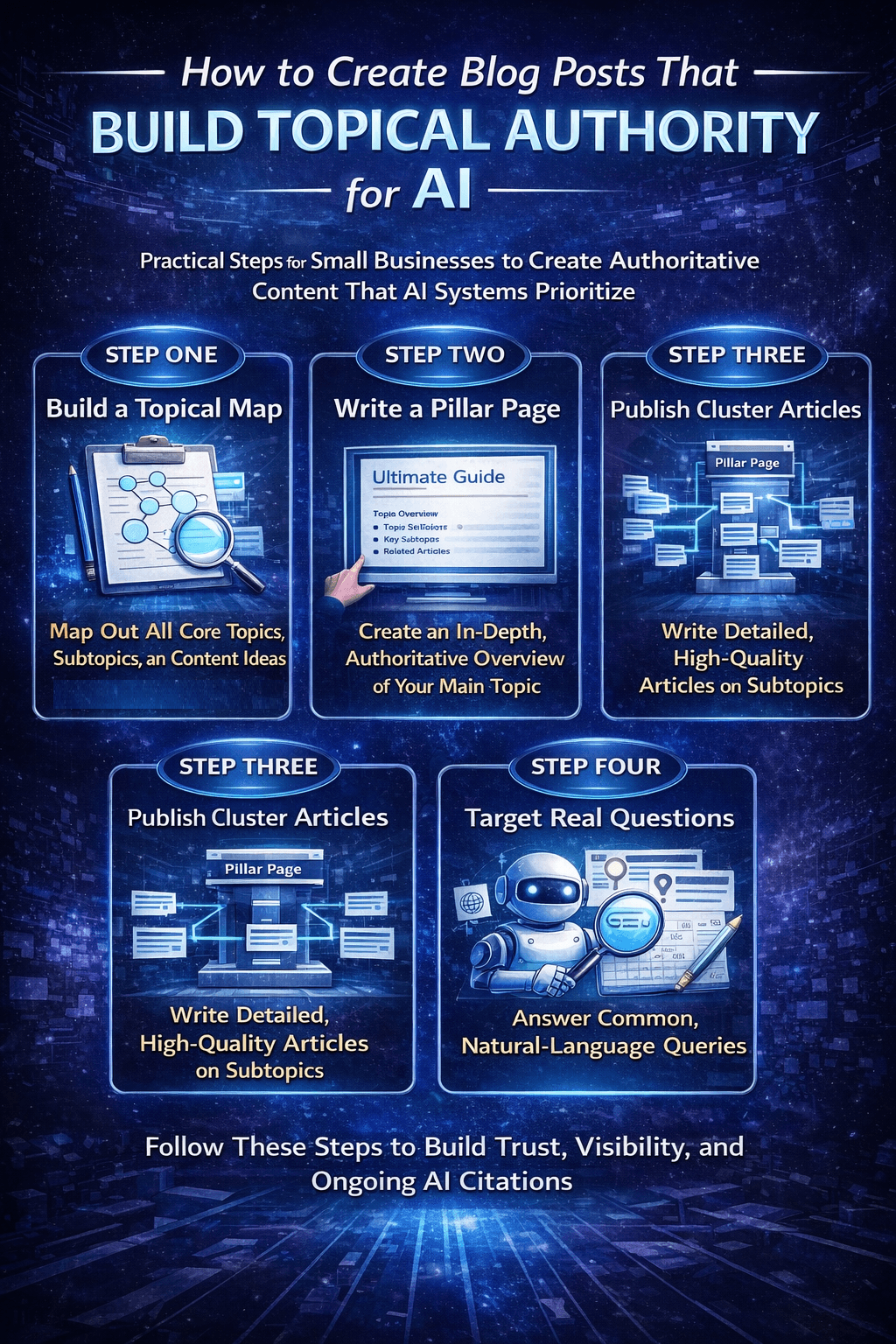
Step One: Start With a Topical Map Before You Write Anything
The single most important thing you can do before writing a single blog post is to build a topical map for your niche. A topical map is a documented plan of all the content your website needs to publish in order to comprehensively cover your core topic. Without one, you will inevitably end up publishing articles in a scattered, reactive way — chasing whatever keyword or trend seems interesting at the time — rather than building a coherent authority ecosystem.
Creating a topical map does not require sophisticated tools, though tools like Semrush’s Topic Research feature, AlsoAsked.com, and even direct queries to AI platforms like ChatGPT can help. At its most basic, building a topical map involves three steps. First, define your core topic — the one subject your website is going to be the definitive resource on. Second, brainstorm every category of question your audience might have about that topic. Third, break those categories down into specific article ideas that together cover the full landscape of the subject. The result is a document that tells you exactly what to write, in what order, and how the pieces connect to each other.
For a small business owner who sells organic skincare products, for example, a topical map might identify the core topic as ‘natural skincare for sensitive skin.’ The main categories might include ingredients, routines, product comparisons, skin conditions, and myths about natural skincare. Within each category, specific article ideas emerge: a guide to identifying clean skincare ingredients, a morning routine for sensitive skin, a comparison of popular natural moisturizers, an article on rosacea-friendly natural skincare products, and a piece debunking common myths about natural ingredients. Together, these articles form a complete cluster that covers the topic from every relevant angle.
Step Two: Write Pillar Pages That Define Your Authority
Once your topical map is in place, the first major content creation task is writing your pillar page. This is the most important single piece of content in your cluster, and it deserves careful attention. A pillar page should provide a comprehensive, authoritative overview of your core topic — broad enough to introduce all the major subtopics, but structured in a way that links out to deeper cluster articles for readers who want more detail on any particular area.
The most effective pillar pages share several characteristics that are worth keeping in mind as you write. They open with a clear, direct explanation of what the topic is and why it matters — because AI systems look for definitional clarity near the top of authoritative documents. They use clear H2 and H3 headings to organize content into logical sections, making it easy for both readers and AI crawlers to navigate. They include a table of contents for longer pieces. And they link explicitly to every cluster article that covers a subtopic in more depth, using anchor text that accurately describes what the linked article contains.
A well-written pillar page for a website focused on topical authority might cover what topical authority is, why it matters in 2026, how topical clusters work, the role of internal linking, and what E-E-A-T signals mean for small business owners — while linking out to separate, dedicated cluster articles on each of these subtopics for readers who want to go deeper on any one of them.
Step Three: Create Cluster Articles That Go Deep on Specific Subtopics
Cluster articles are where the depth of your topical authority actually lives. While the pillar page introduces every major area of your topic, cluster articles are where you demonstrate genuine, granular expertise on each subtopic. Writing a strong cluster article requires a slightly different mindset than writing a general blog post: rather than trying to be broadly useful, your goal is to be the single most useful and complete resource available for a specific, focused question or subtopic.
There are several practical techniques that consistently produce strong cluster articles for building topical authority for AI. Each of these techniques directly addresses one or more of the five pillars discussed earlier in this guide, and applying them together will maximize the impact of every piece of content you produce:
-
-
- Lead with a direct definition or answer: Open each section with a clear, plain-language statement that directly answers the question the section addresses. This answer-first approach makes your content easy for AI systems to extract and cite.
- Use real examples and original perspective: Generic advice that could apply to any business in any industry is exactly the kind of content that AI systems deprioritize. Ground your advice in specific, real-world examples from your own experience or your industry. This originality is a direct E-E-A-T signal.
- Cover the full scope of the subtopic: Aim to answer not just the primary question your cluster article addresses, but the follow-up questions a reader would naturally have after reading the answer. Think about what a genuinely curious reader would want to know next, and address those questions within the same article.
- Include a section-level FAQ: Where appropriate, end sections or the article itself with a short FAQ that captures the most common questions related to the subtopic. FAQ content is disproportionately cited in AI-generated responses because it is structured in exactly the format AI systems use to answer user queries.
- Link back to the pillar page and to related cluster articles: Every cluster article should include at least one internal link back to the pillar page using descriptive anchor text, and at least one cross-link to a related cluster article where the connection is genuinely useful for the reader.
-
When you follow these techniques consistently across your cluster articles, you are not just producing good blog posts — you are building a content architecture that AI systems recognize as authoritative, structured, and trustworthy. That recognition is the foundation of building topical authority for AI search.
Step Four: Optimize for the Questions AI Systems Are Actually Asked
One of the most underused strategies for building topical authority for AI is directly targeting the kinds of conversational, question-based queries that AI platforms receive from users. Traditional SEO has long focused on keyword research using tools like Semrush or Ahrefs, but these tools primarily reflect how people search on Google — often in short, fragmented phrases. AI search is fundamentally different. Users tend to ask AI tools complete, conversational questions rather than short keyword fragments.
Adapting your content to capture these conversational queries is one of the highest-leverage actions you can take for AI citation potential. The process involves identifying the full, natural-language questions your audience asks about your topic — not just the keywords they type — and ensuring your content answers those questions clearly and completely. Several practical research methods can help you identify these questions. Using the ‘People Also Ask’ boxes in Google search results reveals related questions your audience has. Browsing forums, Reddit communities, and Facebook groups in your niche surfaces the real language your audience uses when they are genuinely confused about something. And directly querying AI platforms like Perplexity or ChatGPT with your core topic to see what follow-up questions they suggest is one of the most direct ways to understand what AI systems consider the most important dimensions of your subject.
Research Tip: Open an AI platform such as Perplexity or ChatGPT and type: ‘What are the most common questions people have about [your topic]?’ The questions that come back reflect real patterns in how users interact with AI search — and they are the questions your content should be answering.
Step Five: Maintain and Refresh Your Content Regularly
Publishing a cluster article is not the end of the process — it is the beginning of a maintenance cycle that is essential for sustained topical authority for AI search. Research from multiple AI SEO sources in 2026 consistently shows that freshness is one of the strongest trust signals for AI citation. Content that has not been updated in more than three to six months sees a measurable decline in AI citation frequency, particularly in fast-moving niches where information changes regularly.
For small business owners, building a content maintenance habit does not have to be time-consuming. A quarterly review of your top-performing cluster articles — updating statistics, replacing outdated examples, adding sections that address newly emerging questions, and refreshing the publication date — is sufficient to maintain strong freshness signals. The important thing is consistency. A site where all content is regularly maintained sends a powerful signal of reliability that both AI systems and human readers respond to positively.
How AI Systems Actually Decide What to Cite: What Small Business Owners Need to Know
One of the most common questions from small business owners who are new to building topical authority for AI is a deceptively simple one: how exactly do AI systems decide which sources to cite? Understanding the answer to this question at a practical level will help you make better decisions about every aspect of your content strategy, from the topics you choose to write about to the way you structure individual sentences.
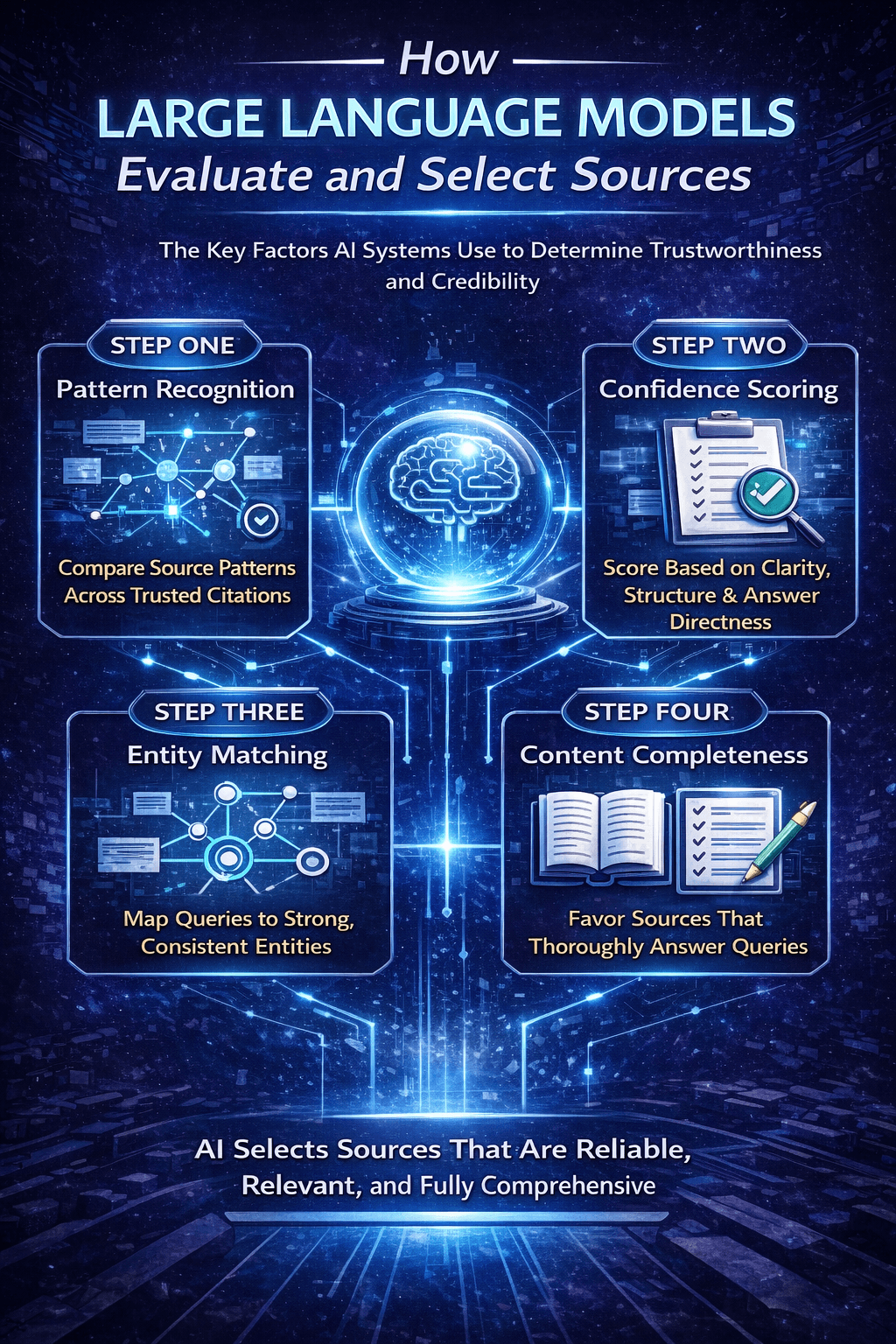
AI systems like ChatGPT and Perplexity do not rank pages the way Google does. They use a fundamentally different process to select sources. According to technical analyses published by Vercel and LLMrefs.com in 2026, large language models evaluate content through a combination of pattern recognition, confidence scoring, entity matching, and content completeness assessment. Understanding each of these evaluation mechanisms will help you align your content strategy with the way AI systems actually process and select sources.
How Large Language Models Evaluate and Select Sources
The evaluation process that AI systems use when deciding which sources to cite involves several distinct but related factors. Each factor contributes to an overall assessment of whether your content is reliable, relevant, and sufficiently comprehensive to be trusted as a source. Here is how each factor works:
-
- Pattern recognition across trusted sources: AI models are trained on vast datasets of web content, and they give the most weight to sources that are consistently referenced by other high-authority content. If established industry publications, Wikipedia-adjacent resources, or well-recognized experts regularly link to or mention your website, you enter the ecosystem from which AI draws its most reliable citations. A single feature or quote in a highly respected publication in your niche can have more impact on your AI citation potential than dozens of backlinks from lower-authority sites.
- Confidence scoring based on clarity and structure: AI systems assess how clearly and directly a piece of content answers a question. Content that buries the key answer in vague preamble, uses jargon without explanation, or structures information in a way that is difficult to parse programmatically receives a lower confidence score than content that is direct, well-structured, and logically organized. This is one of the most actionable insights for content creators: write clearly, define terms explicitly, and put the most important information where AI systems will encounter it first.
- Entity matching: When a user asks an AI system about a specific topic, the AI matches that query to the entities it has mapped from its training data. If your website has a strong, consistent entity profile in the AI’s understanding — meaning that your content consistently reinforces the same core subject with the same clear focus and terminology — your site is more likely to be matched as a relevant source for related queries. Inconsistency in topical focus weakens your entity match scores, which is another reason why staying within a clearly defined niche is so critical for building topical authority for AI.
- Content completeness: AI systems actively favor sources that fully answer a query rather than providing partial responses. A comprehensive guide that addresses a topic from multiple angles, answers likely follow-up questions, and covers both the common and the edge cases of a subject is treated as a more reliable source than a brief article that only scratches the surface. This is the practical rationale behind investing in long-form, thorough cluster articles rather than short, superficial posts.
These four evaluation mechanisms explain why building topical authority for AI is so closely aligned with simply being a genuinely excellent, well-organized resource on your chosen topic. AI systems are not looking for tricks or loopholes. They are looking for the sources that most reliably and completely answer the questions their users ask. If your content does that better than anyone else in your niche, building topical authority for AI becomes a natural consequence of doing excellent work.
The Role of External Validation in Building Topical Authority for AI
While internal factors like content structure, topical depth, and entity clarity are all within your direct control, external validation also plays a meaningful role in how AI systems assess your credibility as a source. According to the 2026 AI SEO strategy checklist published by AiRankingSkool, AI training data is heavily weighted toward content from established journalism, academic publications, government and institutional sites, and high-authority industry resources. Being referenced, quoted, or linked to by sources that AI systems already recognize as highly authoritative is one of the most powerful ways to accelerate your topical authority for AI search.
For small business owners, pursuing external validation does not require a large PR budget or industry connections. Practical strategies include contributing expert commentary to industry roundup articles, participating actively and substantively in relevant online communities such as Reddit and LinkedIn where your insights may be referenced by others, seeking to be quoted or featured in niche publications within your industry, and producing original research or data studies that other creators in your field might naturally want to cite. Each of these activities creates external signals that reinforce the authority profile your content is building internally through your cluster structure and topical map.
Building Topical Authority for AI: A Practical Step-by-Step Action Plan
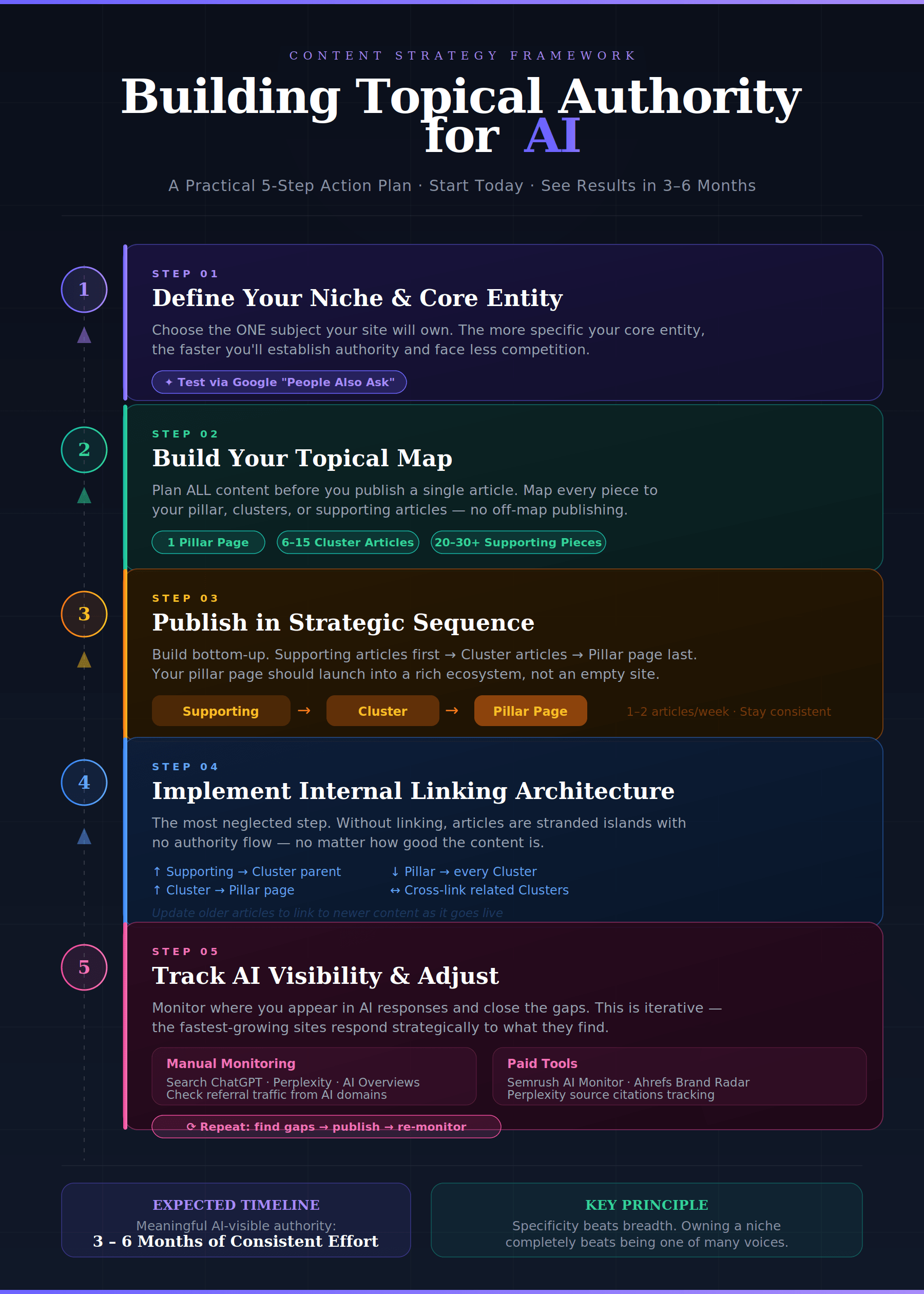
Everything discussed in this guide so far has been building toward a practical framework you can begin implementing today, regardless of the current state of your website. Building topical authority for AI is not something you can accomplish overnight, but with a clear action plan and consistent effort, even a brand-new website can establish meaningful AI-visible authority within three to six months. Here is the step-by-step process that works:
Step One: Lock In Your Niche and Define Your Core Entity
The action plan begins before you open a content editor or start keyword research. Your first task is to clearly and specifically define the one subject your website is going to be the definitive resource on. This is your core entity — the concept that AI systems will associate your website with as you build authority over time. The more specific your core entity, the faster you will establish authority, because you will face less competition for the semantic territory you are claiming.
A useful test for whether your core entity is well-defined: search it on Google and look at the ‘People Also Ask’ and ‘Related Searches’ sections. If Google is already associating it with a clear network of related questions and concepts, you have identified a well-defined entity space. If the search returns vague, scattered results across very different industries or contexts, your entity may need to be more specific. For a small business owner, specificity almost always wins — owning a specific niche completely is far more valuable than being one of many voices in a broad space.
Step Two: Build Your Topical Map
With your core entity defined, the next step is to build your topical map. As described earlier in this guide, this is the document that plans all the content your website needs to publish in order to cover your topic comprehensively. Your topical map should include your one pillar page topic, a set of six to fifteen cluster article topics, and a longer list of supporting article ideas that target specific long-tail questions within each cluster. Aim to identify at least twenty to thirty distinct content ideas before you begin publishing.
Building this map upfront is what separates a purposeful topical authority strategy from random blogging. Every article you publish from this point forward should have a defined place on the map — either as a pillar page, a cluster article, or a supporting piece within a specific cluster. Articles that do not fit the map do not get published, regardless of how appealing their keyword volumes might look. This discipline is the foundation of a coherent content ecosystem.
Step Three: Publish in Strategic Sequence
With your topical map in hand, begin publishing content in the sequence that builds the strongest topical signals the fastest. As described in detail in the companion guide on the Cluster Domination System published on this blog, the most effective publishing sequence starts with supporting articles targeting long-tail, lower-competition questions, followed by cluster articles, and finally the pillar page once the cluster has enough content to support it. This bottom-up approach ensures that your pillar page launches into an ecosystem that already has topical context, rather than appearing as an isolated article on an otherwise empty site.
Consistency matters as much as sequence. Publishing one or two well-researched articles per week within the same topic cluster is more effective than publishing ten articles in a burst and then going silent. AI systems and search engines both respond positively to consistent publishing patterns, which signal that a site is an active, maintained knowledge resource rather than a one-time content dump.
Step Four: Implement Your Internal Linking Architecture
As you publish each new piece of content, add internal links systematically following the rules outlined in the earlier section on strategic internal linking. Link supporting articles up to their parent cluster articles. Link cluster articles up to the pillar page. Link the pillar page out to every cluster article. Cross-link cluster articles to related cluster articles wherever the connection adds genuine value for the reader. And periodically revisit older articles to add links to newer content that was published after them.
This ongoing linking work is one of the most important and most frequently neglected parts of building topical authority for AI. Many small business owners invest heavily in content creation and ignore internal linking, leaving their carefully written articles stranded as isolated pages with no authority flow connecting them to the rest of their site. Committing to internal linking as an integral part of every publishing workflow — not an afterthought — is what separates content strategies that build lasting authority from those that produce good individual articles but never generate cumulative impact.
Step Five: Track Your AI Visibility and Adjust
Unlike traditional SEO, where your ranking position on Google is a direct and easily measurable outcome, measuring your visibility in AI-generated responses requires a slightly different approach. According to the AI SEO strategy guide published by AiRankingSkool and the technical analysis from Vercel’s engineering blog, there are several practical ways to monitor your AI citation presence and identify areas for improvement.
The most direct methods currently available for tracking AI visibility include the following approaches. You can search your core topic in AI platforms like ChatGPT, Perplexity, and Google’s AI Overviews and note whether your site appears as a cited source. You can monitor referral traffic from AI platforms using your web analytics, looking for visits originating from domains like chat.openai.com, perplexity.ai, and bard.google.com. Tools like Semrush’s AI Monitor and Ahrefs’ Brand Radar can track brand mentions and citations across AI platforms and web sources at scale. And monitoring the ‘Source citations’ that platforms like Perplexity display alongside their answers can show you directly which sources they are drawing from for queries related to your topic.
Use this data to identify gaps in your topical coverage — queries related to your niche that are being cited from competitors rather than from your site — and prioritize those gaps in your publishing plan. Building topical authority for AI is an iterative process, and the sites that improve the fastest are those that consistently monitor where they appear in AI responses and respond strategically to what they find.
Common Mistakes That Undermine Building Topical Authority for AI
Even with the best intentions and a sound strategy, certain common mistakes can significantly slow your progress toward building topical authority for AI search. Knowing what these mistakes are — and how to avoid or correct them — can save you months of wasted effort. The following are the most damaging errors that small business owners make when attempting to build topical authority for AI-driven search.
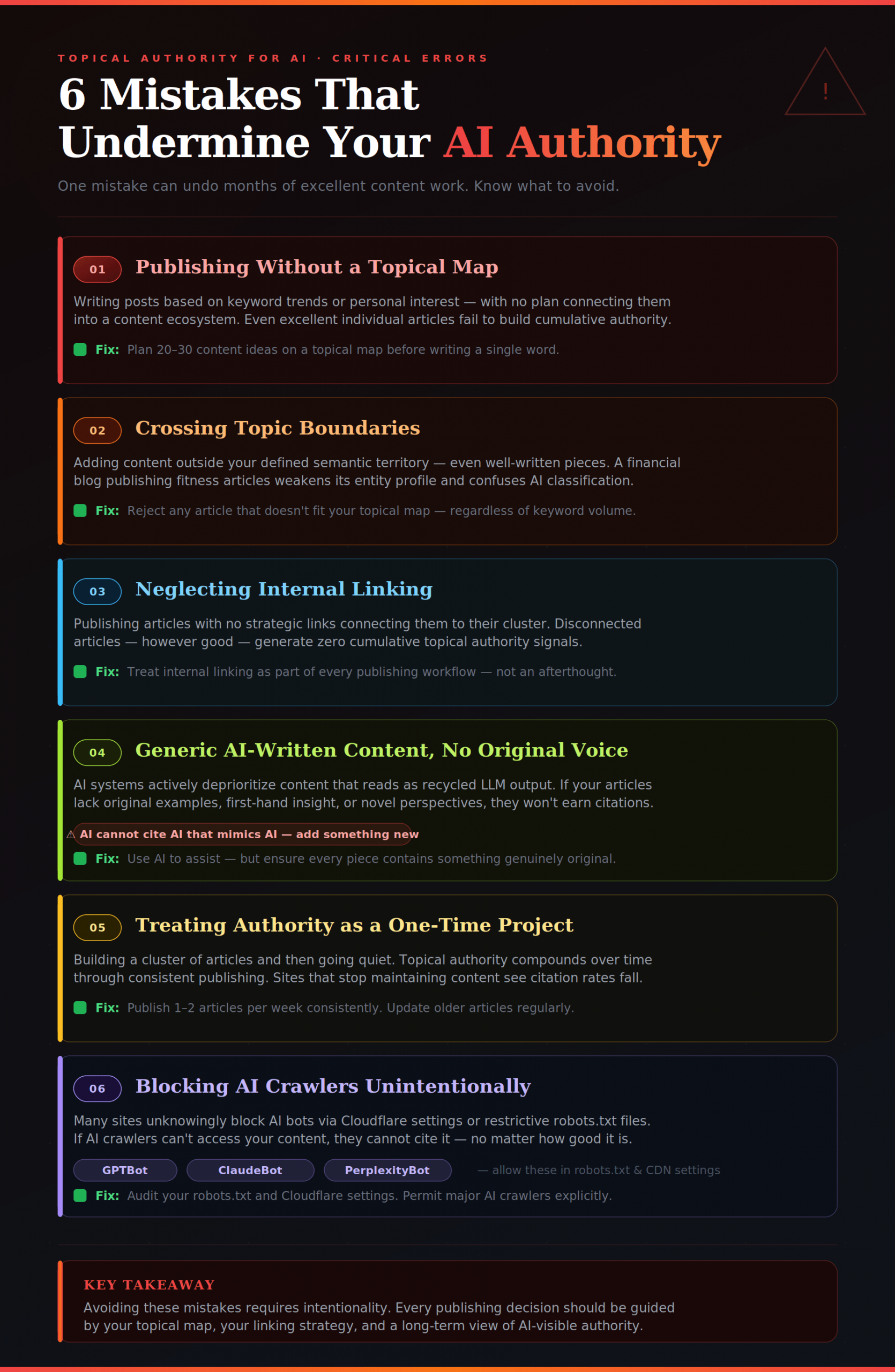
Understanding these pitfalls is just as important as understanding the positive steps, because in many cases a single mistake can undermine otherwise excellent content work. Here are the most critical errors to avoid:
-
- Publishing without a topical map: Writing blog posts based on keyword opportunity or personal interest, without a coherent plan connecting them to a broader content ecosystem. Without a topical map, even excellent individual articles fail to build cumulative authority because they do not demonstrate comprehensive expertise on any single subject.
- Crossing topic boundaries: Including content on your site that falls outside your defined semantic territory, even if individual pieces are well-written. A financial planning blog that occasionally publishes articles on fitness or travel weakens its entity profile and confuses AI systems about what the site is actually an authority on.
- Neglecting internal linking: Publishing articles with no strategic internal links connecting them to the rest of the cluster. Disconnected articles, no matter how good individually, generate zero cumulative topical authority signals.
- Using generic AI-written content without original perspective: LLMrefs.com is direct on this point — AI systems actively deprioritize content that reads as recycled output from other AI models. If your content does not include original examples, genuine first-hand insight, or perspectives that are not already represented in training data, it will not earn citations. Use AI tools to assist your writing process if helpful, but ensure every published piece contains something genuinely new.
- Treating topical authority as a one-time project: Building a cluster of articles and then stopping content creation or maintenance. Topical authority compounds over time through consistent publishing and regular content updates. Sites that stop maintaining their content see citation rates decline within months.
- Blocking AI crawlers unintentionally: Many sites unknowingly block AI crawlers through Cloudflare security settings or overly restrictive robots.txt configurations. If AI bots cannot crawl your content, they cannot cite it. Regularly check your robots.txt file and CDN settings to ensure that major AI crawlers, including GPTBot from OpenAI, are permitted to access your content.
Avoiding these mistakes is not complicated, but it requires intentionality. Every publishing decision should be made with the topical map in front of you, the internal linking strategy in mind, and the long-term goal of building an authoritative, AI-visible content ecosystem as the guiding objective.
Traditional SEO Versus Building Topical Authority for AI Search: Key Differences
To bring together the key concepts covered in this guide, it is helpful to see clearly how building topical authority for AI search differs from the traditional SEO approach that many small business owners have relied on. Understanding these differences will help you evaluate your current strategy and identify where the most impactful changes need to be made.
The table below summarizes the most significant distinctions between the two approaches across several key dimensions of content strategy:
| Traditional SEO Focus | Building Topical Authority for AI |
| Rank individual pages for specific keywords | Become a trusted source across an entire topic ecosystem |
| Optimize each article independently | Build interconnected clusters where each article supports the others |
| Measure success by keyword rankings on Google | Measure success by AI citation frequency and AI platform visibility |
| Backlink quantity is a primary authority signal | Topical depth, entity clarity, and content consistency are primary signals |
| Publish based on keyword volume and trend | Publish based on topical map and strategic cluster sequencing |
| Individual articles can be orphaned and still rank | Every article must be connected to the cluster to generate authority signals |
| Content can remain static once published | Content must be regularly updated to maintain freshness as a trust signal |
| Authority is site-wide and accumulated over years | Topical authority is niche-specific and can be built quickly with focused effort |
Reading through these distinctions, you may notice that building topical authority for AI is not actually in conflict with traditional SEO best practices — it extends and deepens them. The principles of depth, relevance, and credibility that have always underpinned great SEO content are the same principles that AI systems reward. What changes is the emphasis: from individual page optimization to ecosystem building, and from keyword rankings to citation potential.
Conclusion: Building Topical Authority for AI Is the Most Important Content Investment You Can Make in 2026
The shift toward AI-powered search is not a distant future trend. It is happening right now, and the small business owners who begin building topical authority for AI search today are the ones who will maintain organic visibility and competitive advantage as AI-driven discovery continues to grow. Every month you spend publishing scattered, disconnected content without a topical map is a month your competitors have the opportunity to establish the cluster-based authority that AI systems recognize and trust.
The good news is that the strategy for building topical authority for AI is straightforward, practical, and entirely within the reach of a small business owner without a large team or a technical background. Choose your niche. Build your topical map. Publish consistently in strategic sequence. Link everything together with intention. Write with genuine expertise and original perspective. Maintain your content over time. These are not complex technical requirements — they are the practices of a genuinely helpful, well-organized resource. And that is exactly what both your human readers and AI systems are looking for.
If you want to go deeper on any of the strategies covered in this guide, our complete series on topical authority provides detailed companion resources on every aspect of the process. The guide on how to build topical authority covers the structural principles of the cluster model in depth. The article on long-tail content clusters and topical authority explains how to use specific keyword strategies to accelerate your authority growth. And the step-by-step guide on how to gain topical authority fast provides a sequenced framework for building cluster-based authority as quickly as possible. Together, these resources form the complete knowledge base for building topical authority for AI search on your website.
Start today. Build your topical map first. Everything else follows from that.
Frequently Asked Questions About Building Topical Authority for AI
Let us go ahead and have a look at some of the most common and frequently asked questions on the topic of building topical authority for AI:
This is one of the most important questions to understand clearly, because a great deal of confusion exists in the small business community about whether AI search optimization requires abandoning traditional SEO practices entirely. The short answer is: you do not need to choose. Building topical authority for AI search is not a replacement for traditional SEO — it is an evolution of it that makes your traditional SEO work more effective at the same time.
Traditional SEO focuses primarily on optimizing individual pages for specific keywords, building backlinks, and earning high rankings on Google’s search results page. These practices remain relevant in 2026. Google still processes billions of searches per day, and ranking well on traditional search results still drives significant traffic for most small business websites. However, AI-powered platforms — including Google’s own AI Overviews — are increasingly influencing which sources users encounter and trust, and those platforms evaluate sources in ways that differ from traditional keyword-ranking algorithms.
Building topical authority for AI requires a focus on comprehensive topic coverage, structured content, entity clarity, and interconnected cluster architecture. The key insight is that all of these factors also strengthen your traditional SEO performance. A website with a well-built topical cluster and strong internal linking does not just perform better in AI citations — it also ranks higher in traditional search results for a broader range of related keywords, demonstrates stronger E-E-A-T signals to Google’s quality evaluators, and earns more consistent rankings through algorithm updates. The two approaches are mutually reinforcing. Investing in building topical authority for AI search is simultaneously an investment in more resilient, more comprehensive traditional SEO.
The timeline for seeing measurable results from building topical authority for AI search varies based on your niche, the competitiveness of your topic space, the quality and consistency of your content production, and the existing state of your website. However, based on current data from multiple AI SEO case studies published in 2025 and 2026, a realistic timeline for a new website following the cluster-based approach described in this guide is as follows.
Within the first four to eight weeks of implementing a structured cluster strategy, most websites begin to see early indexing signals and initial AI crawling activity. Long-tail supporting articles targeting specific, low-competition questions can begin appearing in both traditional search results and occasional AI citations within this early window, particularly if the content fills genuine gaps in what is currently available on the topic. Between months three and five, as the first complete cluster comes together with a pillar page, full set of cluster articles, and supporting content interlinked effectively, more consistent AI citation activity typically begins to appear. Tools that track AI mentions and citations usually show measurable improvement in this period for sites that are publishing high-quality, well-structured content consistently.
By months six through twelve, websites with multiple interconnected clusters and a strong internal linking architecture generally see compounding returns — each new piece of content benefits from the topical authority already established by the existing cluster, rankings in traditional search become more consistent and broad, and AI citation frequency increases across a wider range of related queries. The important caveat is that these timelines assume consistent, quality-focused publishing rather than sporadic activity. Sites that publish two or three carefully researched cluster articles per week will see results significantly faster than sites that publish one article every few weeks. Building topical authority for AI is fundamentally a compound investment — the results grow larger over time as your cluster ecosystem expands.
This question gets to one of the most genuinely encouraging aspects of the current SEO landscape for small business owners. Building topical authority for AI search is actually one area where small, focused businesses have a structural advantage over large generalist competitors, and where a limited budget is far less of a barrier than many business owners assume.
The reason comes down to what topical authority actually rewards. Large corporate websites typically have huge content libraries spread across dozens of unrelated topics, accumulated over years of unfocused publishing. From an AI authority perspective, this breadth without depth is a weakness, not a strength. A small business website that publishes twenty carefully researched, deeply interconnected articles on a single focused niche can genuinely outperform a major brand’s website in AI citations for that specific topic area, because the small business demonstrates clear, coherent expertise while the large brand’s content on the same topic is buried among thousands of unrelated articles.
From a practical budget perspective, building topical authority for AI does not require expensive tools, paid link-building campaigns, or large content teams. The most important investments are time, subject matter expertise, and a consistent publishing schedule. Free tools like Google’s ‘People Also Ask’ sections, AlsoAsked.com, and direct queries to AI platforms can do most of the keyword and topic research work that paid tools do at a fraction of the cost. Writing thorough, accurate, well-structured articles on your area of genuine expertise — consistently, over time, within a defined topical map — is the core of the strategy, and that requires commitment more than it requires budget. For small business owners who know their subject matter well and are willing to invest in a systematic content approach, building topical authority for AI is one of the most accessible and impactful marketing strategies available in 2026.