


Something fundamental shifted in search over the past twelve months, and most small business owners haven’t caught up yet. This shift has a name: Generative Engine Optimization, or GEO. And at the heart of every effective GEO strategy is something small business owners already have the capacity to build — topical authority for AI search.
If you’ve noticed that your organic traffic has started to flatten — or even dip — despite publishing regular blog content, you’re not imagining things. The way people find information online is undergoing its biggest transformation since Google replaced the original web directories back in the early 2000s. AI-generated answers now appear at the top of the results page for the majority of searches, and the websites that get cited inside those answers are the ones capturing attention, trust, and traffic.
Pursuing this kind of AI search visibility isn’t about abandoning what you already know about SEO. It’s about understanding how AI systems decide which websites to trust enough to cite in their answers, and then structuring your content strategy to meet that standard. The good news is that the websites AI systems favor most are focused, deeply knowledgeable, and well-organized — exactly the kind of site a thoughtful small business can become, without a massive team or a huge budget behind it.
This guide will walk you through everything you need to know: what GEO actually means, why topical authority for AI works differently from traditional search authority, how AI systems evaluate and cite content, and a practical, step-by-step strategy you can start implementing this week. By the time you finish reading, you’ll have a clear picture of exactly what your website needs to become a trusted source in the era of AI-powered search.
Table of Contents
This guide covers every stage of building a GEO strategy — from understanding what AI search (and then topical authority for A search) actually is, to implementing the practical steps that earn your small business consistent citations in AI-generated answers. Use the sections below to navigate directly to what matters most to you right now.
What Is GEO — Generative Engine Optimization?
Generative Engine Optimization, or GEO, is the practice of structuring and presenting your content so that AI-powered search systems choose to cite it when generating answers for users. The term was originally introduced in academic research from Princeton, Georgia Tech, and The Allen Institute in 2023, and it has since become one of the most important disciplines in modern digital marketing.
To understand why GEO matters for your small business, it helps to understand exactly what’s changed. When someone types a query into Google in 2026, they’re increasingly met with an AI-generated answer at the very top of the page — a synthesized response that pulls from multiple websites and presents a summary before showing any traditional blue links. These are called Google AI Overviews, and research shows they now appear on more than sixty percent of all searches. Similar AI answer systems are built into ChatGPT, Perplexity, Microsoft Copilot, and Gemini, all of which are now used by millions of people every day as their primary way of finding information.
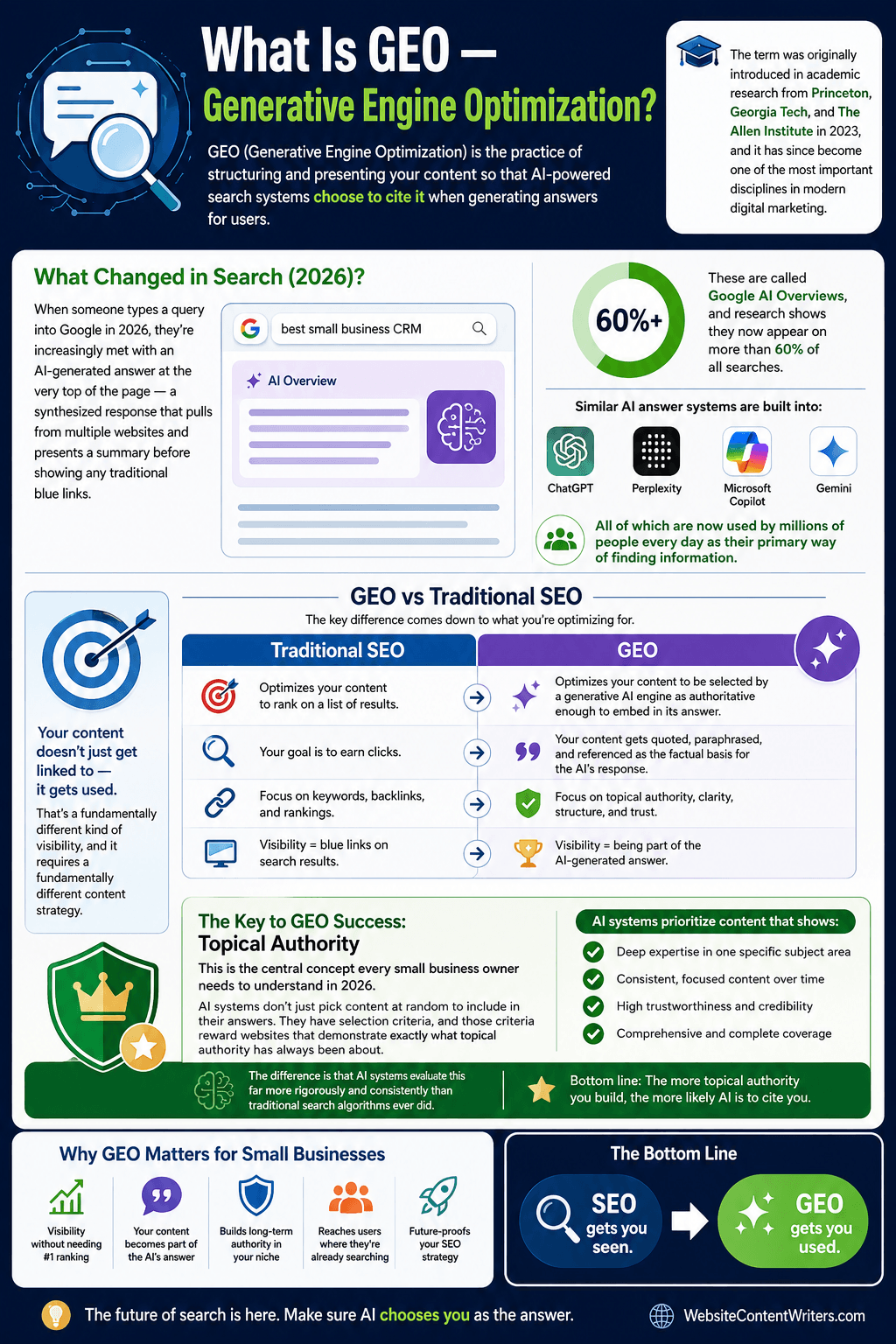
The key difference between GEO and traditional SEO comes down to what you’re optimizing for. Traditional SEO optimizes your content to rank on a list of results. GEO optimizes your content to be selected by a generative AI engine as authoritative enough to embed directly into its synthesized answer. Your content doesn’t just get linked to — it gets quoted, paraphrased, and referenced as the factual basis for the AI’s response. That’s a fundamentally different kind of visibility, and it requires a fundamentally different content strategy.
This is where topical authority for AI search becomes the central concept every small business owner needs to understand in 2026. AI systems don’t just pick content at random to include in their answers. They have selection criteria, and those criteria reward websites that demonstrate exactly what topical authority has always been about: comprehensive, focused, trustworthy expertise in a specific subject area. The difference is that AI systems evaluate this far more rigorously and consistently than traditional search algorithms ever did.
How AI Search Interprets Topical Authority
Topical authority is not only evaluated by traditional search engines as a measure of content depth and internal linking. In AI-powered search systems, authority is inferred through a combination of content coverage, entity relationships, and cross-source consensus.
Instead of simply ranking pages, AI systems evaluate whether a site consistently demonstrates understanding across an entire topic space. This means authority is not a single-page signal—it is a site-level pattern derived from multiple interconnected documents.
Why Topical Authority for AI Search Works Differently
If you’ve been working on your website’s SEO for a while, you’ve probably heard about the importance of building authority. In traditional SEO, authority is largely determined by external factors — how many other websites link to yours, how old your domain is, and what your domain rating looks like in tools like Ahrefs or Semrush. This approach uses some of those same signals, but it adds several layers that traditional SEO never required — and it weights them very differently.
How AI Systems Decide What to Cite
AI search engines operate using what’s called a Retrieval-Augmented Generation (RAG) pipeline. In plain terms, this means that when someone asks an AI system a question, the system first searches the web for the most relevant and trustworthy content it can find, then synthesizes that content into a coherent answer. It evaluates each candidate source against a set of criteria, and the sources that score highest become the ones cited in the final response.
Understanding those evaluation criteria is the key to building topical authority for AI effectively. The signals AI systems use when selecting sources fall into several clear categories, and knowing what they are lets you design your content strategy around them from the start. AI systems assess sources based on the following factors before deciding whether to cite them.
-
- Topical relevance and depth: The content must be clearly and comprehensively relevant to the specific question being asked — not just broadly related to the subject area.
- Structural clarity: AI systems read heading hierarchies, paragraph structure, and formatting to understand what each section covers. Well-organized content is far more extractable.
- Factual accuracy and citation: Content that references verifiable data, links to authoritative sources, and cites credible research is treated as more trustworthy by AI systems.
- Author credentials and E-E-A-T signals: Visible author information, demonstrated expertise, and trust signals across the page influence how heavily a source is weighted.
- Domain-wide topical consistency: AI systems don’t just read one page — they evaluate whether your entire website consistently covers the relevant subject area.
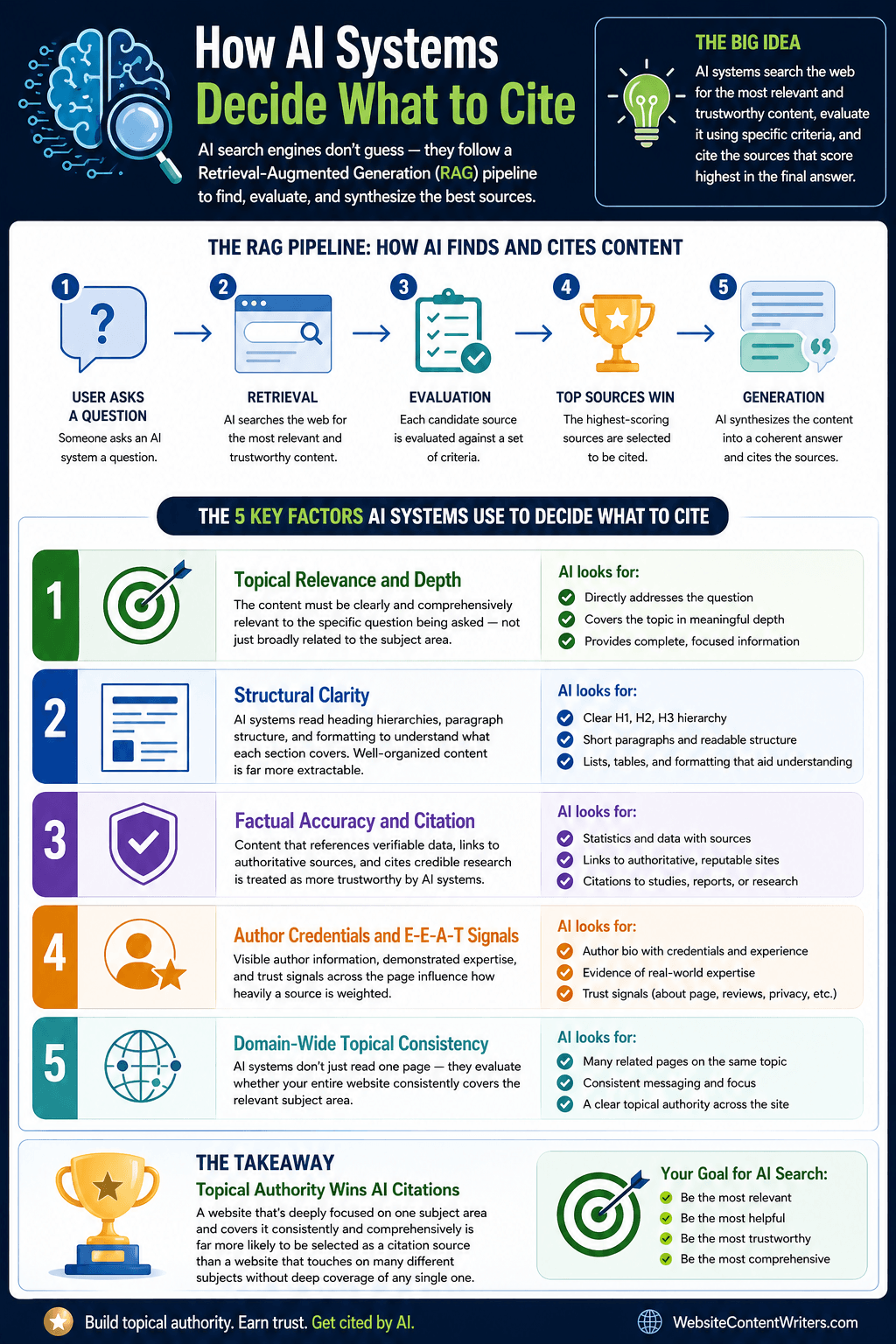
That last point is what makes this approach so valuable for small businesses in particular. A website that’s deeply focused on one subject area and covers it consistently and comprehensively is far more likely to be selected as a citation source than a website that touches on many different subjects without deep coverage of any single one.
Topic Clusters vs Topic Graphs (AI Search Upgrade)
Traditional topic clusters are structured around a pillar page and supporting articles. However, AI search systems interpret content less as clusters and more as topic graphs.
A topic graph is a network of entities and relationships. Instead of isolated clusters, authority emerges when a site covers multiple interconnected concepts such as entities, subtopics, and contextual relationships.
For example, a “credit cards” cluster does not only include articles about credit cards—it also includes relationships to credit scores, APR, banking systems, and reward structures.
The Connection between Focused Expertise and AI Visibility
AI systems think in terms of entities and concepts, not just keywords. When a generative engine decides whether your website is a credible source on a given topic, it’s not just checking whether you’ve mentioned the right terms. It’s building a model of what your website genuinely knows — which topics you cover comprehensively, which questions you address in depth, and how consistently your content demonstrates real expertise rather than surface-level coverage.
This is precisely why topical authority for AI search demands a content strategy built around depth and focus rather than volume and breadth. A website with thirty deeply researched, interconnected articles all covering different aspects of, say, small business bookkeeping will be recognized as a genuine authority on that subject. A website with two hundred articles covering bookkeeping, travel destinations, recipe ideas, and product reviews will not be recognized as an authority on anything — even if its individual articles are well-written.
Research from Search Engine Land confirms that this GEO strategy is best understood as a long-term visibility discipline, not a short-term optimization tactic. The websites that appear most consistently in AI-generated answers are those that have established clear, focused expertise over time — and the ones that have structured their content in a way that makes that expertise easy for AI systems to recognize and extract.
How Topical Authority for AI Search Has Changed the Game for Small Business Owners
Before getting into the practical strategy, it’s worth spending a moment on the scale of what’s actually changed — because the shift is bigger than most people realize, and it directly affects whether your small business website grows or stagnates over the next twelve months.
Entity Coverage Layer (Missing Step in Most SEO Strategies)
Beyond keywords and subtopics, modern search systems rely heavily on entity recognition. Entities are real-world concepts such as people, products, organizations, and ideas that define how topics are structured in machine understanding.
To build true topical authority, a site must ensure entity coverage is complete and consistent. This means identifying all key entities within a topic and ensuring they are referenced, explained, and connected across content.
For example, a finance site covering credit cards should not only mention “credit cards,” but also entities such as credit bureaus, APR systems, issuing banks, and reward mechanisms.
Zero-Click Searches and What They Mean for Your Website
The rise of AI Overviews and AI-generated answers has dramatically increased what the industry calls zero-click searches — queries that are fully answered by the AI without the user ever needing to click through to a website. Research shows that more than sixty percent of Google searches in 2026 now end without a click. For small business owners who’ve built their traffic strategy around getting people to click blue links, that’s a significant disruption.
It doesn’t mean that getting traffic from search is impossible. It means that the type of visibility that matters has shifted. Being cited inside an AI-generated answer — even when the user doesn’t click — builds brand recognition, signals credibility, and influences purchasing decisions in ways that are harder to measure but very real in their impact. According to data from Semrush cited by Jasper.ai, visitors who arrive at a website via an AI platform convert at a rate four-point-four times higher than visitors from traditional organic search. The users who do click through from AI results are already pre-sold on your authority because the AI has already vouched for you.
This strategy, then, isn’t just about traffic — it’s about being the business that AI systems trust enough to name when potential customers are asking the exact questions your products or services answer.
The Opportunity Hidden in Topical Authority for AI Search for Small Business Owners
Here’s the part that most small business owners miss when they first encounter GEO: the competitive landscape inside AI search looks nothing like the competitive landscape in traditional search. In traditional SEO, you’re competing against every website on the internet that has targeted your keywords, many of them with years of domain authority and hundreds of backlinks your newer site can’t match. In AI search, you’re competing on a different dimension entirely — and it’s one where a focused, consistent, well-structured small business website has a genuine structural advantage.
Large corporate websites frequently suffer from what SEO professionals call topical dilution. They cover so many subjects across so many different product lines and departments that AI systems can’t reliably identify them as the authoritative source on any specific topic. A small business website that has built genuine topical authority for AI in a focused niche — say, sustainable event catering, or cybersecurity for medical practices, or tax planning for freelance designers — can outperform those corporate giants within that niche precisely because its expertise is clear, deep, and consistent.
According to research from Foundation Inc., data from over eight million AI-generated responses shows that AI systems actively seek diversity in their sources, frequently pulling from smaller, specialized publishers alongside major platforms. The window to establish that kind of focused AI search presence in your niche is still wide open in 2026 — and the earlier you start building it, the more durable your position becomes.
The Four Foundations of Topical Authority for AI Search
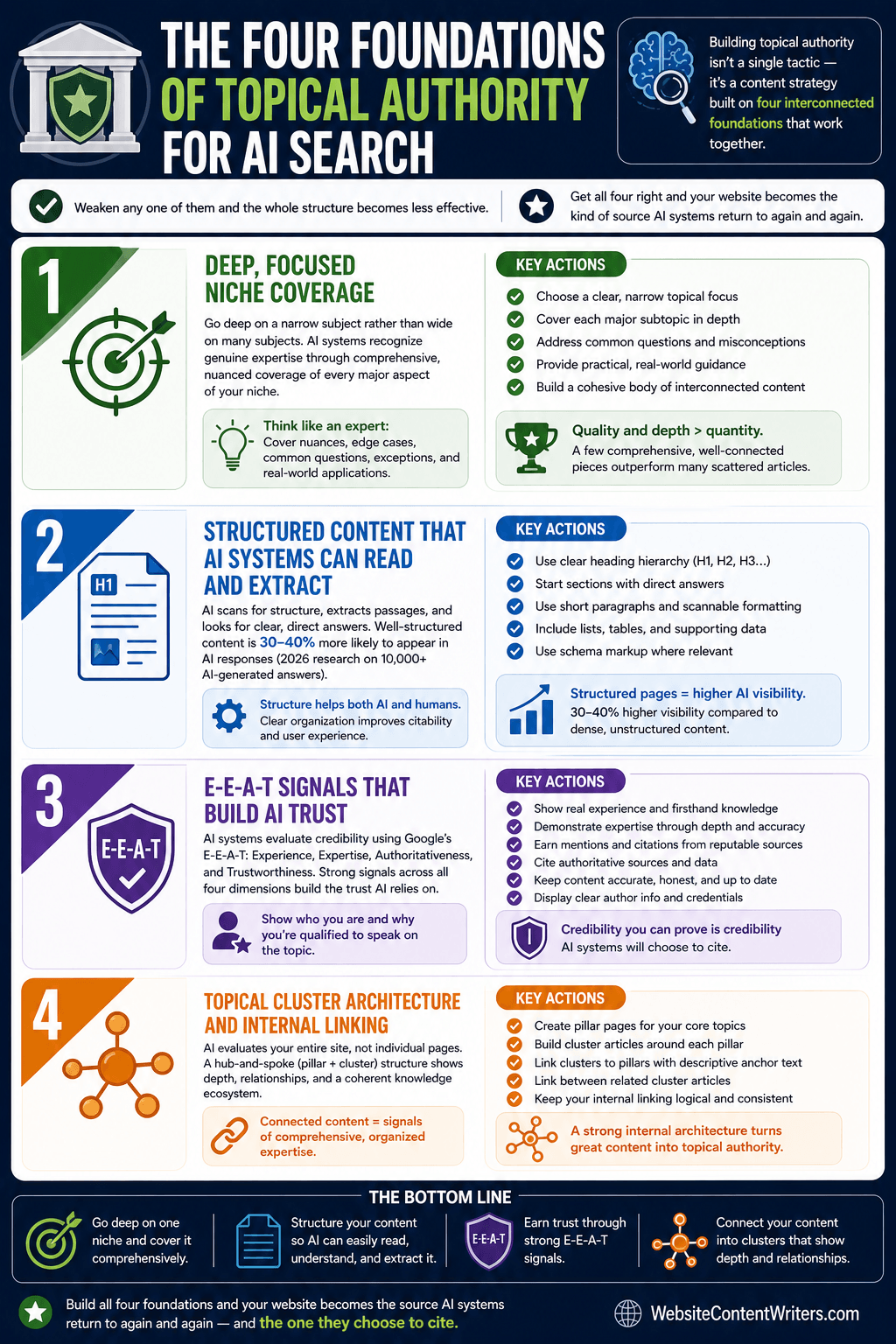
Building it isn’t a single tactic — it’s a content strategy built on four interconnected foundations that work together. Weaken any one of them and the whole structure becomes less effective. Get all four right and your website becomes the kind of source AI systems return to again and again.
Foundation One: Deep, Focused Niche Coverage
The first and most important foundation here is the decision to go deep on a narrow subject rather than wide on many subjects. This goes against the instinct many small business owners have when they start a blog — the impulse is to write about anything relevant to the business, which often leads to scattered content that doesn’t signal expertise in any particular area.
AI systems are trained to recognize genuine expertise, and genuine expertise is characterized by comprehensive coverage. Think about what distinguishes an expert’s knowledge from a generalist’s: the expert doesn’t just know the headline topics — they know the nuances, the edge cases, the frequently misunderstood concepts, and the practical application details that only come from deep experience. Your content needs to reflect that same depth. For every major subject within your niche, your website should have content that covers it from multiple angles, addresses the most common questions, explores the exceptions and complications, and provides practical guidance based on real-world application.
This doesn’t mean you need to publish hundreds of articles before your GEO strategy starts working. What matters is that the content you do publish is organized coherently around a clear topical focus, with each piece adding to a cumulative picture of comprehensive expertise. Building topical authority through focused, interconnected content is far more effective for AI visibility than publishing a large volume of loosely related articles.
Foundation Two: Structured Content That AI Systems Can Read and Extract
AI systems don’t read your content the way human readers do. They scan for structure, extract relevant passages, and assess whether specific sections clearly and directly address the query being answered. Content that’s well-structured for AI readability looks different from content written purely for human engagement, and building an effective GEO content strategy requires you to think about both audiences simultaneously.
The formatting practices that most improve AI readability are straightforward to implement but require a deliberate shift in how you approach each article. Research published in 2026 analyzing more than ten thousand AI-generated responses found that pages with structured content — including clear heading hierarchies, direct-answer formatting, and supporting data — had between thirty and forty percent higher visibility in AI responses compared to pages with the same information presented in dense, unbroken prose. That’s a meaningful difference, and it’s entirely within your control to address with every piece of content you publish.
Structuring content for AI citability doesn’t mean sacrificing readability for human audiences. The same clarity and organization that makes content easy for AI systems to parse also makes it easier for human readers to navigate and absorb. It’s an investment that pays dividends with both audiences at once.
Foundation Three: E-E-A-T Signals That Build AI Trust
Google’s E-E-A-T framework — which stands for Experience, Expertise, Authoritativeness, and Trustworthiness — was originally developed to guide human quality raters in evaluating content. In 2026, it’s equally central to how AI systems evaluate content credibility. Building the kind of credibility AI systems trust means demonstrating all four dimensions of E-E-A-T clearly and consistently across your website.
Experience means showing that your content comes from someone who has real, first-hand involvement with the subject — not just theoretical knowledge about it. Expertise means demonstrating the depth and accuracy of your subject-matter knowledge through the content itself. Authoritativeness means being recognized as a credible voice not just on your own website but across the broader web — through mentions, citations, and references from other reputable sources. Trustworthiness means that your content is accurate, honestly presented, clearly sourced, and consistent over time.
For small business owners, the most actionable of these signals are the ones directly within your control. Making sure every article has a clearly identified, credentialed author, linking to authoritative external sources when you cite data or statistics, using real examples from your own business experience, and keeping your published information current and accurate are all concrete steps that directly strengthen your E-E-A-T signals — and by extension, your topical authority for AI search.
Foundation Four: Topical Cluster Architecture and Internal Linking
The fourth foundation of topical authority for AI search is the structural organization of your content — specifically, how your articles are connected to each other through a deliberate hub-and-spoke architecture. AI systems don’t evaluate pages in isolation. They crawl your entire website and build a model of what topics you cover, how deeply you cover them, and how clearly the relationships between your content pieces are signaled.
A well-built topical cluster structure — where a comprehensive pillar page covers the broad topic and multiple focused cluster articles cover specific subtopics, all linked together through descriptive internal links — sends exactly the signal AI systems are looking for. It shows that your website’s coverage of a subject isn’t a collection of isolated articles but a coherent, structured knowledge ecosystem that reflects genuine expertise. Without this architecture, even excellent individual articles fail to accumulate the authority they’d achieve if they were properly connected within a cluster.
Why Internal Linking Alone Is Not Enough for AI Search
Internal linking helps establish structure for traditional search engines, but AI search systems evaluate authority using broader signals than link topology alone.
While internal links define how content is organized, AI systems prioritize whether content clusters collectively cover a topic space with sufficient depth and entity coherence.
In other words, internal linking supports authority—but does not create it without comprehensive topic coverage.
Building Your GEO Strategy: A Step-by-Step Guide
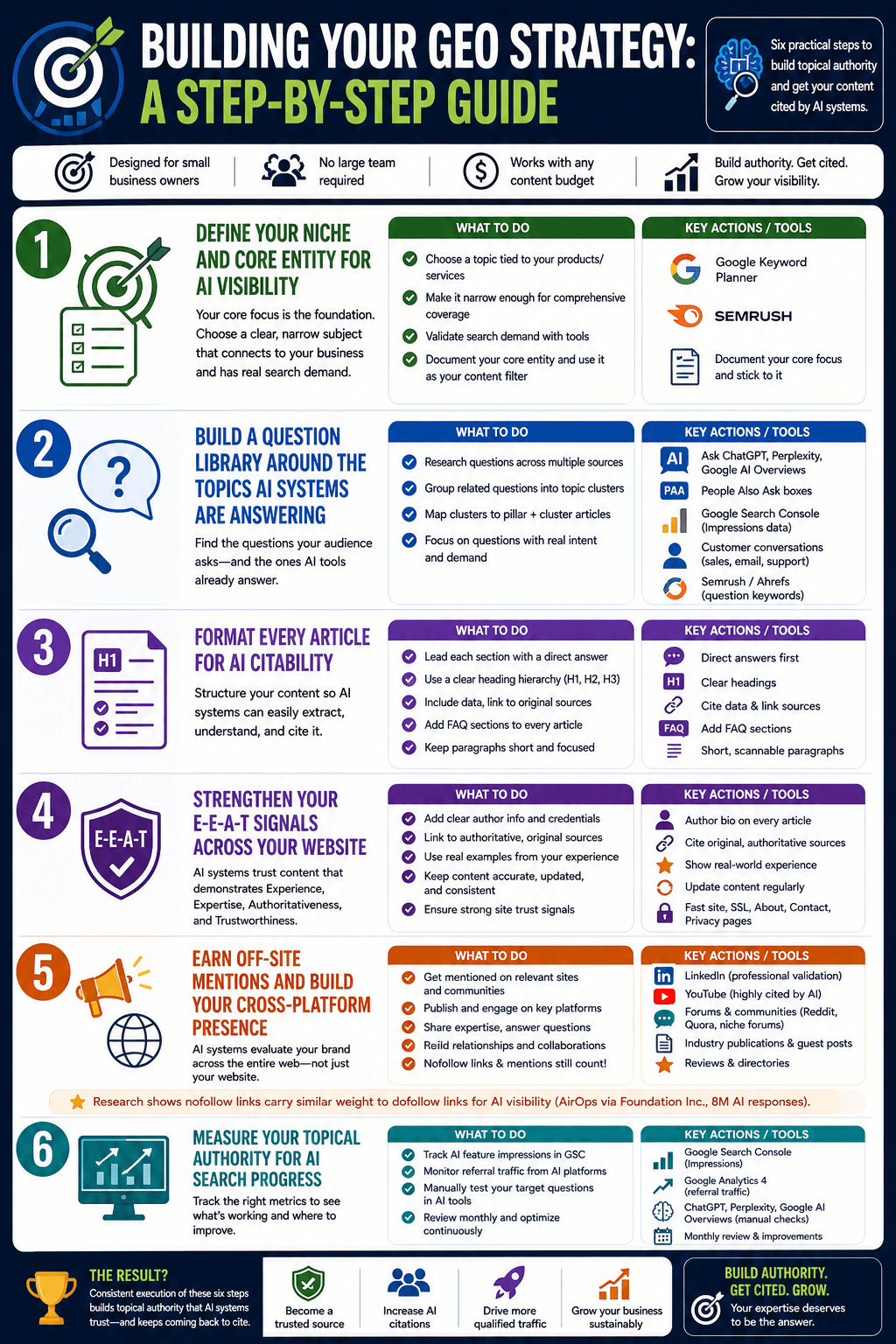
Understanding the principles behind topical authority for AI search is one thing. Turning that understanding into a concrete content strategy you can actually execute is another. The following six steps walk you through building a GEO strategy designed specifically for small business owners who don’t have a large team or an unlimited content budget.
Step One — Define Your Niche and Core Entity for AI Visibility
The first step in building topical authority for AI is making a clear, committed decision about what your website’s core subject area is. This is the single most important decision in your entire GEO strategy because every other step flows from it. The more focused and specific this choice is, the faster your AI search presence will develop and the more effectively AI systems will recognize you as a credible source.
Your core entity should have three characteristics that make it work well as the foundation of an AI-focused content strategy. First, it must directly relate to the products or services your business provides — there’s no value in building AI visibility around a subject that doesn’t attract potential customers. Second, it must be narrow enough that comprehensive coverage is achievable — a solo practitioner or a small team can’t realistically build a deep AI search presence around a subject as broad as “business” or “health,” but they can absolutely do it for “employee retention strategies for small restaurants” or “natural skincare routines for sensitive skin over forty.” Third, there must be actual search demand — use Google Keyword Planner or Semrush to verify that real people are asking questions within your chosen niche.
Once you’ve identified your core entity, document it clearly and make it the filter through which every content decision passes. Every article you publish, every question you answer, every piece of content you add to your website should connect meaningfully to that core focus — or it doesn’t belong in your GEO strategy.
Step Two — Build a Question Library around the Topics AI Systems Are Answering
The second step is researching the specific questions your target audience is asking, with particular attention to how those questions are being answered by AI systems today. Building topical authority for AI requires a different kind of keyword research than traditional SEO. Instead of focusing primarily on search volume and keyword difficulty, you’re looking for the questions that AI tools like Google AI Overviews, ChatGPT, and Perplexity are currently synthesizing answers for — because those are the answers your content needs to be good enough to contribute to.
Several practical research methods will help you build a comprehensive question library for your content strategy. Using a combination of these approaches gives you a much more complete picture of the question landscape than relying on any single source.
-
-
- Direct AI querying: Ask ChatGPT, Perplexity, and Google AI Overviews the questions your customers commonly ask, and study which sources are cited in the answers. Those cited sources are your immediate competitors for AI visibility.
- Google’s People Also Ask boxes: Search your core topic and explore the related questions that appear. These represent exactly the kinds of questions that AI Overviews are built to answer.
- Google Search Console: Review your Impressions data for queries where your content is already being surfaced but not yet generating clicks. These represent near-miss opportunities where a stronger, better-structured article could begin earning AI citations.
- Customer conversations: The questions your customers ask most often in sales calls, emails, and support conversations are frequently the same questions they’re typing into AI tools. These first-hand insights are invaluable for building content that addresses genuine user needs.
- Semrush or Ahrefs keyword research: Filter specifically for question-format keywords within your core topic area, as these are the most directly aligned with how AI systems receive and respond to queries.
-
Once you’ve compiled your question library, group the questions into logical topic clusters. Each cluster becomes the basis for a set of related articles — a pillar page covering the broad topic and multiple cluster articles diving deep on specific subtopics. This grouping is the structural foundation of your topical authority for AI strategy.
Step Three — Format Every Article for AI Citability
The third step is implementing the specific formatting practices that make your content extractable by AI systems. Every article you write for your GEO strategy should follow a clear set of structural principles that serve both your human readers and the AI systems that evaluate your content. Understanding these principles before you start writing is far more efficient than retrofitting them after the fact.
The most impactful formatting practices for AI citability are consistent and learnable. Applying them to every article you publish is what transforms a collection of good writing into a content library that builds AI citation authority systematically over time.
-
-
- Lead each section with a direct answer: Put the key point of each section in the first one or two sentences, before adding context, examples, or elaboration. AI systems extract passages, not full articles — they’re looking for clear, direct statements they can incorporate into a synthesized answer.
- Use a clear heading hierarchy: Every article should have one H1, with H2 headings for major sections and H3 headings for subsections. Each heading should clearly describe the topic of its section, making it easy for AI systems to understand what each part of your article covers.
- Include supporting data and cite your sources: AI systems treat factual claims backed by verifiable data as more trustworthy than opinion or general assertion. When you cite a statistic, link to the original research. When you make a claim, explain the evidence behind it.
- Add FAQ sections to every article: FAQ sections are among the most AI-friendly content formats available, because they present pre-structured question-and-answer pairs that AI systems can directly extract and incorporate into their responses.
- Keep paragraphs focused and digestible: Long, dense paragraphs are harder for AI systems to parse cleanly. Shorter, tightly focused paragraphs make your content more extractable and improve the readability for your human audience at the same time.
-
Applying these formatting principles consistently across your content library is one of the fastest ways to improve your overall AI search visibility, because it makes your existing expertise more visible and accessible to the AI systems that evaluate it.
Step Four — Strengthen Your E-E-A-T Signals across Your Website
Step four involves a site-wide review of your E-E-A-T signals — the credibility and trust indicators that AI systems use alongside content quality when evaluating whether a source is worth citing. Many small business owners have never given these signals serious attention because they didn’t feel relevant to traditional SEO. In the world of topical authority for AI search, they’re no longer optional.
Start with authorship. Every article on your website should have a clearly identified author whose name, role, and relevant credentials are visible on the page. If your website currently publishes content without author attribution, adding it is one of the single fastest improvements you can make for your topical authority for AI strategy. AI systems are specifically trained to assess whether content comes from a real, qualified person — and anonymous content is treated with significantly less credibility.
Next, review your factual citations. Go through your existing articles and wherever you’ve cited data, statistics, or research findings, check that those citations link to the original source — not to another blog post that referenced it. Linking directly to authoritative external sources, including peer-reviewed research, government data, or well-respected industry publications, signals to AI systems that your content is grounded in verifiable facts rather than speculation.
Finally, check your site’s technical trust signals. Make sure your website loads quickly on both desktop and mobile, that your SSL certificate is active, and that your Contact page, About page, and any privacy or legal pages are easy to find. These signals matter less for individual article quality but contribute to the overall domain-level trust that AI systems factor into their source evaluation.
Step Five — Earn Off-Site Mentions and Build Your Cross-Platform Presence
Step five takes your GEO strategy beyond the boundaries of your own website. Building topical authority for AI isn’t just about what you publish on your domain — it’s about how your brand and expertise are recognized across the wider web. AI systems don’t just read your website; they build an understanding of your brand from everything they can find about you across the entire internet.
Off-site brand mentions are one of the most underrated GEO signals. Research from AirOps, cited in a comprehensive analysis of eight million AI-generated responses by Foundation Inc., found that nofollow links carry essentially the same weight as dofollow links for AI visibility — because AI systems treat links as recognition signals rather than authority transfer mechanisms. This means that mentions of your business name and expertise across forums, review platforms, industry publications, and community sites like Reddit all contribute to your broader AI search standing, even when those mentions aren’t linked.
Actively building your presence on the platforms that AI systems cite most frequently is a concrete action you can take today. LinkedIn is consistently cited as a source of professional validation across multiple AI platforms. YouTube is one of the top-cited sources in both Gemini and Perplexity. Industry-specific forums and community platforms contribute significantly to how AI systems understand category-level conversations. Publishing thoughtful content on these platforms — not just on your own website — extends your AI visibility well beyond your own domain and makes your expertise recognizable from multiple angles.
Step Six — Measure Your Topical Authority for AI Search Progress
The sixth and final step is setting up the tracking systems that let you see whether your GEO strategy is working and where to focus your ongoing efforts. Measuring topical authority for AI search requires a different set of metrics from traditional SEO measurement, and many small business owners don’t realize that the data they need is largely available through tools they already have access to.
Start with Google Search Console. Filter your Impressions data to identify queries where your content is appearing in AI-driven features, and track those impressions over time. An increase in impressions without a corresponding increase in clicks is often a sign that your content is being surfaced in AI Overviews — users are seeing your content cited, even without clicking through to your website. That’s still a positive signal and worth tracking carefully.
Next, set up traffic source tracking in Google Analytics to identify sessions that arrive from AI platforms. Sessions from perplexity.ai, chatgpt.com, and claude.ai are trackable as direct referral sources, and monitoring this traffic gives you concrete data on how often AI tools are sending visitors your way. You can also monitor manually — simply asking ChatGPT, Perplexity, or Google AI Overviews the questions your content targets, and checking whether your website is cited in the responses, takes only a few minutes and gives you direct insight into your current AI visibility.
Review this data monthly and use it to prioritize your content improvements. If a particular topic cluster is generating strong AI impressions but your content isn’t being cited in responses yet, that’s a signal to revisit the article’s structure, deepen its coverage, or strengthen its E-E-A-T signals. This is an iterative process, and consistent measurement is what keeps your strategy moving in the right direction.
GEO vs. Traditional SEO: What Changes and What Stays the Same
One of the most common questions small business owners have when they first encounter GEO is whether it replaces traditional SEO or works alongside it. The answer is unambiguous: GEO and traditional SEO are complementary, not competing, disciplines. In fact, strong traditional SEO remains the foundation on which effective GEO is built — but the two differ meaningfully in their emphasis and their measurement.
Traditional SEO optimizes for ranking in a list of results. It’s primarily concerned with getting your page to appear near the top of the search results page when someone searches for a specific keyword. The metrics are familiar: keyword ranking position, organic click-through rate, and organic traffic volume. GEO, by contrast, optimizes for being selected by a generative AI as a trusted source in its synthesized answers. The metrics are different: AI citation frequency, brand mention tracking across AI platforms, and referral traffic from AI tools.
What’s important to understand is that these two goals reinforce each other. Research from Jasper.ai shows that nearly forty percent of Google’s AI Overviews cite content that ranks in the top ten organic results, and nearly seventy percent cite content that ranks in the top one hundred. This means that your traditional SEO performance directly feeds your GEO visibility. A website that ranks well for traditional search is significantly more likely to be cited in AI Overviews than one that doesn’t — because AI systems draw heavily from the pool of content that Google already trusts.
The practical implication is clear: don’t abandon your traditional SEO strategy in favor of GEO. Maintain and strengthen your traditional SEO — publishing optimized, high-quality content, building your internal linking structure, keeping your technical SEO clean — while adding the GEO-specific layers on top: structured formatting for AI extractability, E-E-A-T strengthening, and off-site presence building. Together, these efforts compound into a search visibility strategy that works across both the traditional and AI-powered search environments.
Common GEO Mistakes That Undermine Your Topical Authority for AI
Even small business owners who understand GEO in theory often make several predictable mistakes when implementing it. Knowing what these mistakes look like — and why they undermine your topical authority for AI — helps you avoid them from the start rather than discovering them months into your strategy.
The most damaging mistake is treating GEO as a one-time technical fix rather than an ongoing content strategy. Installing schema markup on your website is useful, but schema alone doesn’t establish genuine AI search credibility. AI systems recognize genuine expertise that’s demonstrated through comprehensive, consistently published, well-organized content over time. A website that adds schema markup but continues publishing scattered, surface-level content in no particular topical order won’t see meaningful improvements in AI visibility, because the structural changes haven’t addressed the underlying problem: the absence of deep, focused expertise.
Another common mistake is ignoring content freshness. Research from LLMrefs found that AI citation rates for specific pages drop sharply when content becomes more than three months out of date for fast-moving topics. AI systems have a significant recency bias — they favor content that includes current data, up-to-date statistics, and references to recent developments in the field. Reviewing and refreshing your most important articles at least quarterly, adding updated figures and new examples where relevant, is one of the most efficient ways to maintain and grow your topical authority for AI over time.
A third mistake is publishing articles in isolation without connecting them to a coherent cluster structure. Every article you publish should link to related articles on your own website, and those articles should link back to it. A page that exists as an island — with no internal links pointing to or from it — is far less likely to build your AI search standing than a page that’s clearly positioned within a structured, interconnected cluster of related content. Use the Topical Clusters SEO Analyzer to identify orphan pages in your existing content and connect them properly into your topical structure.
Finally, many small business owners make the mistake of targeting topics that are too broad for their website’s current authority level. Trying to build deep AI search authority around a subject like “digital marketing” when your website has twenty articles and no established credibility is a recipe for slow, frustrating progress. Start with a narrow, specific niche where comprehensive coverage is achievable, establish strong AI visibility there, and then expand your topical map as your domain authority and citation track record grow.
Tools That Support Your Topical Authority for AI Search and GEO Strategy
You don’t need a large technology stack to start building topical authority for AI effectively. The tools that matter most at the small business level are a combination of platforms you may already be using and a few targeted additions.
Google Search Console is the most valuable free tool in your GEO toolkit. It shows you exactly which queries are generating impressions for your content, where your click-through rates are lagging behind your impression counts (often a sign of AI Overview visibility without clicks), and how your overall search performance is trending over time. Using Search Console data to identify high-impression, low-click queries gives you a prioritized list of articles to restructure and strengthen for AI citability.
For content research and topical gap analysis, Semrush and Ahrefs both offer features that help you identify which questions within your niche are generating significant search activity, what your competitors are ranking for that you aren’t, and where your content library has gaps that need to be filled to build comprehensive AI search authority. Both platforms have paid plans, but even their entry-level tiers offer enough capability to drive a meaningful content strategy for a small business website.
For auditing and improving the topical structure of your existing content, the Topical Clusters SEO Analyzer provides a clear, accessible picture of how your current content is organized, where your cluster architecture has gaps, and which pages are sitting as orphans without the internal links they need to contribute fully to your AI search performance. It’s built specifically for small business owners who want actionable insights without needing to interpret complex technical data — and it’s the fastest way to understand exactly where your content structure needs strengthening before you invest further in new content creation.
How AI Search Selects Sources (Not Just Ranks Them)
In AI-powered search systems, ranking and citation are not the same process.
First, documents are retrieved based on relevance to a query. However, not all retrieved documents are used in final AI-generated responses. Instead, a secondary selection process determines which sources are trusted enough to be cited.
This means that even highly optimized pages may not appear in AI answers if they lack sufficient entity depth, consistency across topics, or cross-source validation.
Therefore, topical authority is best understood as a precondition for selection, not a guarantee of visibility.
Conclusion
The shift to AI-powered search isn’t coming — it’s already here, and it’s already determining which small business websites capture attention and which ones get left behind. The websites that will thrive in this environment aren’t necessarily the biggest or the oldest. They’re the ones that have built genuine, structured, consistently demonstrated expertise in a focused subject area — the ones that have made building topical authority for AI a central pillar of their content strategy.
The good news is that this is entirely achievable for a small business, with thoughtful planning and consistent execution over time. You don’t need to publish a hundred articles before you start seeing results. You need to choose your niche clearly, organize your content around a coherent cluster structure, format every article for AI readability, strengthen your E-E-A-T signals, and show up consistently on the platforms where AI systems go to understand what credible expertise in your field looks like.
Building topical authority for AI search is, at its core, about becoming genuinely useful to the AI systems that are now mediating between your potential customers and the information they’re looking for. When you do that well, those AI systems will cite you — not just once, but consistently, building a level of brand credibility and trust that compounds over time and drives qualified traffic that converts at a meaningfully higher rate than traditional search visitors.
If you’re ready to strengthen your content structure and start building the foundation that effective AI search authority requires, our SEO services and free analyzer are built to help small business owners do exactly that — without needing to become an SEO expert first.
Topical Authority Diagnostic Checklist (AI Search Edition)
To evaluate whether a site is truly topically authoritative in AI-driven search systems, assess the following:
-
- Does the site cover all major subtopics within the domain?
- Are entities consistently defined and reused across pages?
- Do multiple pages reinforce the same topic relationships?
- Is content structured as a network rather than isolated articles?
- Does the site appear across multiple related query variations?
- Is it cited or referenced across multiple independent sources?
If most answers are “no,” the site may rank in traditional search but will struggle in AI-generated results.
Frequently Asked Questions about Topical Authority for AI Search
Here are some of the most common asked questions about topical authority for AI search:
What is the difference between GEO and traditional SEO, and do I need to choose between them?
GEO and traditional SEO aren’t competing strategies — they’re complementary layers of a unified visibility approach, and choosing one over the other would be a strategic mistake. Traditional SEO focuses on earning high positions in the list of organic results that appears below the AI-generated answer. GEO focuses on being cited within that AI-generated answer — becoming part of the response itself rather than a link beneath it.
The critical insight is that these two goals reinforce each other directly. Research shows that close to forty percent of Google’s AI Overview citations come from pages that rank in the top ten traditional organic results, which means your traditional SEO authority directly increases your probability of being cited in AI answers. A site with strong topical authority for AI and strong traditional SEO performance gets the best of both: it earns AI citation visibility and generates clicks from users who scroll past the AI answer to the organic results below.
For small business owners, the practical approach is to maintain your traditional SEO fundamentals — good on-page optimization, solid technical performance, consistent internal linking — while adding the GEO-specific layers on top: structured content formatting, E-E-A-T signals, FAQ sections, and off-site presence building. This combined approach ensures you’re visible regardless of whether a given user engages with the AI answer or the traditional results beneath it, and it future-proofs your strategy against further shifts in how search engines present results.
The timeline for seeing meaningful results from a GEO strategy depends on several factors, but there are some reasonable benchmarks that give you a realistic picture of what to expect at each stage of execution.
Structural and technical changes — including adding schema markup, improving heading hierarchies, and adding FAQ sections to existing articles — can begin showing impact within two to four weeks, particularly for Google’s AI Overviews, which process schema-enriched content relatively quickly. These are the fastest wins available to small business owners who want to see early movement.
Content quality and topical cluster improvements take longer to materialize, but they’re also more durable. Expect two to three months of consistent content creation and structural improvement before you begin seeing measurable increases in AI citation impressions and referral traffic from AI platforms. The reason for this timeline is that AI systems need to crawl your updated content, evaluate the improvements to your cluster architecture, and incorporate your site into their evolving model of who the credible sources are in your niche.
By months four through six, small business owners who have built genuine topical authority for AI — through comprehensive cluster coverage, structured formatting, and consistent E-E-A-T strengthening — typically begin seeing compounding results. New articles get cited faster because your domain’s credibility has been established. Existing articles that have been updated and restructured begin generating AI citation impressions consistently. Traffic from AI platforms like Perplexity and ChatGPT starts appearing in your analytics as a measurable referral source.
The most important thing to understand about this timeline is that the authority you build doesn’t reset between algorithm updates or model retraining cycles. Unlike short-term SEO tactics that can be erased overnight, authority built on genuine expertise and structured content is a durable asset that compounds over time.
Can a small business website really compete with large brands in AI search results?
Yes — and in many cases, a well-focused small business website has a genuine structural advantage over large corporate websites in AI search, for reasons that are specific to how AI systems evaluate and cite sources.
Large brands suffer from topical dilution. A corporation with thousands of pages covering dozens of different product lines, service areas, and content topics cannot demonstrate the focused, deep expertise in any single area that AI systems weight most heavily when selecting citation sources. A small business website that has methodically built topical authority for AI within a specific niche — through thirty to fifty deeply researched, well-structured, interconnected articles — will consistently outrank that corporation for AI citations within that niche.
Data from AirOps, analyzing millions of AI-generated responses, found that focused niche publishers regularly appear in AI answers ahead of major brand websites when their content is more clearly structured, more comprehensive within a specific topic area, and more directly aligned with the query being answered. Research from Enrich Labs supports this further, noting that citation authority in AI search compounds based on consistency and depth of coverage — not on the overall size or age of the domain.
The actionable implication for small business owners is to resist the temptation to broaden your content strategy in an attempt to compete at scale. The way to win topical authority for AI against larger competitors is to go narrower and deeper than they’re willing to go — to become the definitive, most comprehensively useful resource on a specific subject that genuinely matters to your target customers. That’s a goal that’s fully achievable with consistent effort, thoughtful strategy, and the kind of first-hand expertise that a small business owner brings to their subject area by virtue of doing the work every day.
Ready to start building topical authority for AI that actually gets your business cited in search results? Use the Topical Clusters SEO Analyzer to see how your current content structure stacks up — and discover exactly where to focus your efforts first.