


If you have been publishing blog posts consistently but still struggle to rank on Google, the problem is rarely your effort or even your writing quality. In most cases, the real issue is a lack of structure, which is why understanding what is a topical map can completely change your results.
Many small business owners create content without a clear plan, hoping that targeting a few keywords will be enough. However, modern search engines look beyond individual articles and evaluate how your entire website is organized. This is where learning about topical maps becomes essential. These maps are not just a list of ideas. It is a structured blueprint that connects your content, builds topical authority, and helps search engines understand your expertise.
When you fully understand a topical map what is, you move from guessing what to write next to following a proven system that supports long-term growth. Instead of publishing isolated posts, you begin creating a connected content ecosystem that works together to improve rankings, increase visibility, and drive consistent traffic to your website.
Search engines in 2026 do not rank content the way they did in the past. Instead of evaluating individual articles in isolation, they analyze how your entire website is organized. They look for depth, consistency, and clear relationships between topics.
This is where understanding the answer to “What is a topical map?” becomes essential.
A topical map is not just another SEO concept. It is the foundation behind every website that consistently ranks across dozens or even hundreds of keywords. Without it, your content is scattered. With it, your content becomes a system that helps in building topical authority over time.
This guide will walk you through everything you need to know in plain English. By the end, you will understand what a topical map is, why it matters, and how to create one step by step—even if you have no prior SEO experience.
What Is a Topical Map?
A topical map is a structured content plan that organizes all the topics your website covers around a central subject. It shows what content you should create, how each piece connects, and how everything works together to demonstrate expertise.
Instead of writing random blog posts based on ideas or keywords, a topical map gives you a clear blueprint. It ensures every article has a purpose and contributes to a larger strategy.
At its core, a topical map includes three things:
-
- A main topic that defines your website’s focus
- Supporting subtopics that explore that subject in depth
- Internal connections that link everything together
This structure allows search engines to understand your website more easily. It also helps your readers move naturally from one piece of content to another.
When someone asks, “What is a topical map?” the simplest answer is this:
A topical map is the plan that turns your blog into a complete, organized knowledge system.
Why Understanding What Is a Topical Map Matters for SEO
Many small business owners believe SEO is about keywords. While keywords still matter, they are no longer the main factor.
Search engines now prioritize topical authority, which means how well your website covers an entire subject.
Understanding what a topical map is matters, because it is the system that builds that authority.
Without it:
-
- Your content feels disconnected
- Search engines cannot clearly identify your expertise
- Rankings remain inconsistent
But, with it:
-
- Your content reinforces itself
- Your site becomes easier to crawl and understand
- Your rankings improve across multiple related keywords
A topical map creates a compounding effect. Each new article strengthens the others, making your entire website more powerful over time.
What Is a Topical Map and what is a Keyword List?
At first glance, a topical map may seem similar to a keyword list. Both involve planning content around search terms. However, they serve completely different purposes.
A keyword list focuses on individual phrases. It tells you what people are searching for, but it does not explain how those searches connect.
A topical map focuses on relationships. It organizes topics in a way that mirrors how real knowledge is structured.
To answer “what is a topical map?” more clearly, it helps to compare the two approaches.
A keyword-based approach might include:
-
- how to save money
- budgeting tips
- reduce expenses
A topical map approach would organize those into a structured system:
-
- Personal finance (pillar topic)
- Budgeting basics
- Saving strategies
- Debt management
- Personal finance (pillar topic)
The difference is not just organization. It is clarity. A topical map turns scattered ideas into a cohesive strategy that search engines can recognize as expertise.
Why You Should Build a Topical Map before Writing Content
One of the most common mistakes small business owners make is writing content first and planning later.
It feels productive to publish regularly, but without a topical map, those efforts rarely produce strong results.
Understanding what is a topical map helps you avoid this mistake by shifting your focus from activity to strategy.
When you write without a plan:
-
- Articles become isolated
- Internal links are weak or missing
- Authority signals are diluted
When you build a topical map first:
-
- Every article has a defined role
- Content supports other content
- Your website grows in a structured way
Think of it like building a house. Writing articles without topical maps is like adding rooms without a blueprint. Each room may look good on its own, but the house does not function properly. This is because they ensure everything fits together from the start.
The Three Core Components of a Topical Map
To fully understand what is a topical map, you need to understand its structure. Every effective topical map is built on three layers.
The Core Topic
The core topic is the main subject your website focuses on. It defines your niche and determines what your content will cover.
A strong core topic should:
-
-
-
- Match your business services or products
- Have enough search demand
- Allow for multiple subtopics
-
-
Choosing the right core topic is critical. It sets the direction for your entire content strategy.
Pillar Pages
Pillar pages are comprehensive guides that cover a broad topic at a high level. They act as the central hub of your content.
A pillar page typically:
-
-
-
- Covers a topic in depth
- Links to multiple related articles
- Provides a complete overview
-
-
Pillar pages help search engines understand the importance of a topic within your site.
Cluster Content
Cluster content consists of detailed articles that focus on specific subtopics. These articles support the pillar page and expand on individual ideas.
Each cluster article:
-
-
-
- Targets a specific question or keyword
- Links back to the pillar page
- May link to related cluster articles
-
-
Together, these three components form a complete topical map.
How Search Engines Use a Topical Map
Understanding what topical maps are also means understanding how search engines interpret it.
Search engines build a model of your website based on:
-
- Content structure
- Topic relationships
- Internal links
Well-structured topical maps make this process easier. It allows search engines to quickly identify:
-
- What your site is about
- How deeply you cover a subject
- Which pages are most important
This leads to better rankings, not just for targeted keywords, but for related searches as well.
What Is a Topical Map in the Age of AI Search?
Search has changed significantly with the rise of AI tools. Platforms now generate answers by analyzing multiple sources rather than simply listing links.
In this environment, knowing the answer to “What is a topical map?” becomes even more important.
AI systems prefer:
-
- Well-structured content
- Clear topic coverage
- Strong internal relationships
Websites with a clear topical map are more likely to be:
-
- Cited in AI-generated answers
- Trusted as authoritative sources
- Visible across multiple platforms
This means topical maps are no longer optional. It is essential for visibility in modern search.
How to Create a Topical Map Step by Step
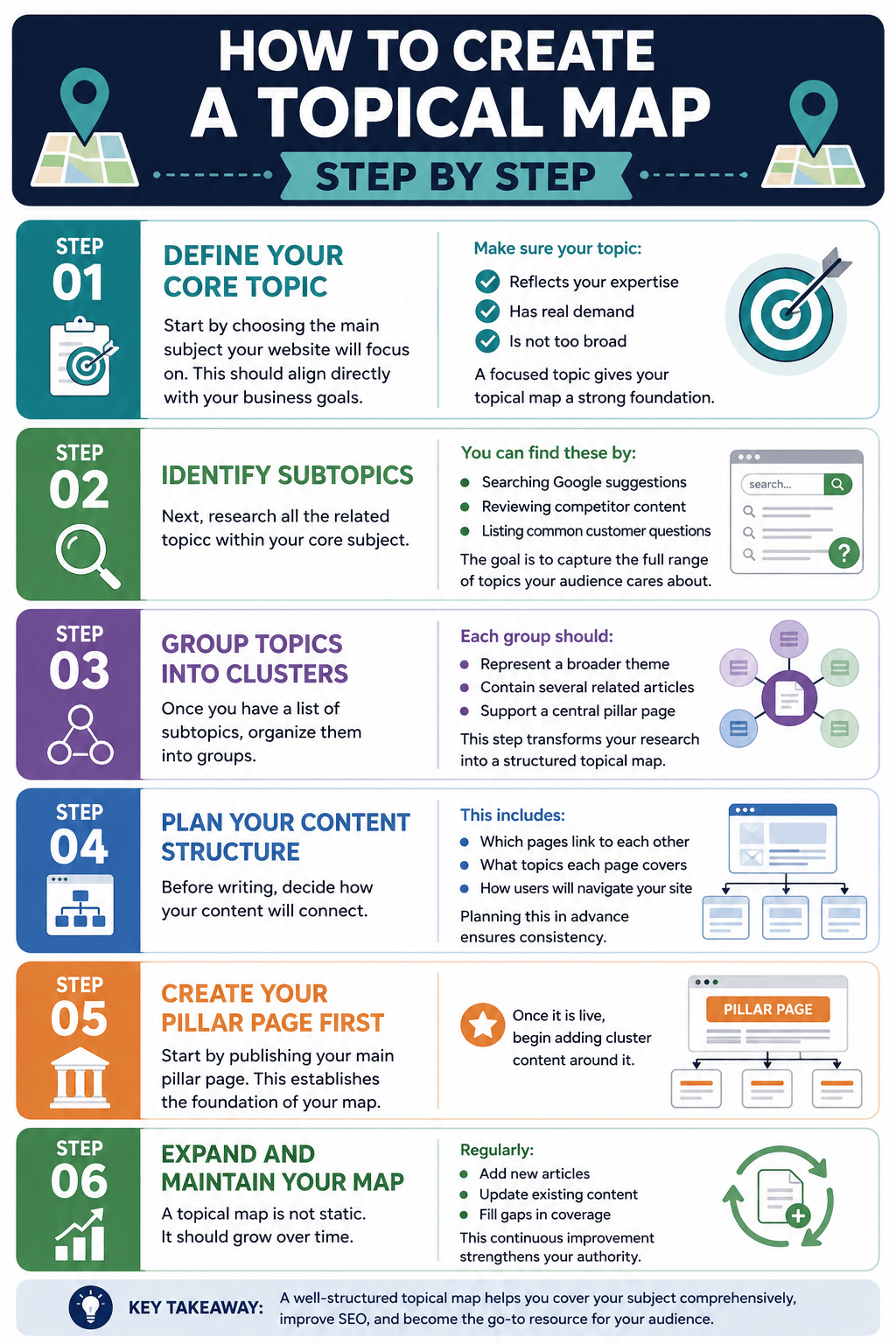
Creating topical maps may sound complex, but it becomes manageable when broken into steps:
Step One: Define Your Core Topic
Start by choosing the main subject your website will focus on. This should align directly with your business goals.
Make sure your topic:
-
-
-
- Reflects your expertise
- Has real demand
- Is not too broad
-
-
A focused topic gives your topical map a strong foundation.
Step Two: Identify Subtopics
Next, research all the related topics within your core subject.
You can find these by:
-
-
-
- Searching Google suggestions
- Reviewing competitor content
- Listing common customer questions
-
-
The goal is to capture the full range of topics your audience cares about.
Step Three: Group Topics into Clusters
Once you have a list of subtopics, organize them into groups.
Each group should:
-
-
-
- Represent a broader theme
- Contain several related articles
- Support a central pillar page
-
-
This step transforms your research into a structured topical map.
Step Four: Plan Your Content Structure
Before writing, decide how your content will connect.
This includes:
-
-
-
- Which pages link to each other
- What topics each page covers
- How users will navigate your site
-
-
Planning this in advance ensures consistency.
Step Five: Create Your Pillar Page First
Start by publishing your main pillar page. This establishes the foundation of your map.
Once it is live, begin adding cluster content around it.
Step Six: Expand and Maintain Your Map
A topical map is not static. It should grow over time.
Regularly:
-
-
-
- Add new articles
- Update existing content
- Fill gaps in coverage
-
-
This continuous improvement strengthens your authority.
Real-World Example of a Topical Map
Understanding topical maps becomes easier with an example.
Imagine a small fitness business focusing on beginners.
Core topic:
-
- Fitness for beginners
Pillar page:
-
- Complete beginner’s guide to fitness
Cluster topics:
-
- home workouts
- beginner nutrition
- workout mistakes
- fitness routines
Each article connects back to the main guide and to related topics.
This creates a structured system that search engines can recognize as expertise.
Common Mistakes to Avoid
Even when people understand what a topical map is, mistakes can still happen.
Some of the most common include:
-
- Choosing a topic that is too broad
- Ignoring internal linking
- Publishing content without structure
- Failing to update content
Avoiding these mistakes ensures your map works effectively.
How a Topical Map Builds Authority over Time
A topical map is not just about organization. It is about growth.
Each new piece of content:
-
- Adds depth to your site
- Strengthens existing pages
- Improves overall visibility
Over time, this creates a powerful effect where your website becomes a trusted resource in your niche.
This is how small businesses compete with larger websites.
Tools That Can Help You Create a Topical Map
While you can create it manually, tools can make the process easier.
Some useful options include:
-
- Google Search Console
- Keyword research tools
- Spreadsheets for organization
For small business owners who want a simpler approach, using a dedicated tool designed for topical mapping can save time and reduce complexity.
Conclusion
Understanding topical maps is one of the most important steps you can take to improve your website’s SEO.
It shifts your strategy from random content creation to structured growth. Instead of guessing what to write, you follow a clear plan that builds authority over time.
For small business owners, this approach is especially powerful. It allows you to compete with larger websites by focusing on depth and organization rather than scale.
If your current content is not producing results, the issue may not be effort. It may be structure. A topical map gives you that structure.
Start with one core topic, build your first pillar page, and expand from there. Over time, your website will transform into a complete resource that both search engines and users trust.
Frequently Asked Questions
What is a topical map in simple terms?
It is a plan that organizes all the content on your website around one main subject. It shows what to write, how topics connect, and how everything works together to build authority.
How long does it take to see results from topical maps?
Most websites begin seeing improvements within four to eight months. Results depend on consistency, content quality, and competition, but the impact grows over time as your content expands.
Can a small business benefit from a topical map?
Yes. A topical map helps small businesses focus on specific topics and build deep expertise. This makes it possible to compete with larger websites by being more organized and targeted.