


If you’ve been publishing blog posts consistently and still can’t rank on page one, the problem isn’t your content — it’s your structure.
Most websites fail because they treat SEO like a collection of random articles. They target isolated keywords, publish disconnected posts, and hope Google eventually rewards them. It rarely does. Without a clear system, your content lacks the depth needed to build topical authority, which is now one of the strongest ranking factors in modern SEO.
What actually works today is a smarter, more strategic approach: long-tail content clusters. Instead of chasing broad, competitive keywords, this method focuses on grouping highly specific long-tail queries into tightly connected content hubs that signal expertise and relevance to search engines.
In this guide, you’ll learn what long-tail content clusters are, exactly how to build long-tail content clusters step by step, how they strengthen your topical authority, and how to structure your content so it can rank faster in Google — even if your site is new or has low authority.
You’ll also learn exactly why long-tail content clusters are the most powerful lever available to small and mid-sized websites today, and how to build a complete cluster from scratch — step by step — to boost online branding and SEO ranking.
By the end, you’ll have a repeatable system you can apply to any niche, any industry, and any stage of site authority.
Why Your Blog Posts Aren’t Ranking (The Real Reason)
Let’s be blunt about what’s happening in search right now.
Google’s algorithm has moved well beyond simple keyword matching. After a series of core updates — including the June 2025 core update that explicitly reinforced topical authority signals — Google now evaluates your entire site when deciding whether to rank any individual page.
That means one great article targeting a good keyword isn’t enough. Google wants to know: does this site actually understand the topic it’s writing about? Does it cover the subject from multiple angles, answer related questions, and connect its content in a logical way?
If your site looks like a collection of disconnected posts on vaguely related topics, Google won’t trust it enough to surface it prominently — even if any individual article is genuinely excellent.
The evidence is hard to ignore. According to a 2025 analysis from HireGrowth, content organized into clusters drives approximately 30% more organic traffic and holds its rankings significantly longer than standalone pieces. That gap is only growing as Google gets better at evaluating topical depth.
The fix is building content clusters — and using long-tail keywords as the engine that makes them accessible and scalable, especially for newer or smaller websites.
What Is Topical Authority (And Why It’s Now the Core of SEO)?
Topical authority is the measure of how much Google trusts your website as a reliable, comprehensive resource on a given subject.
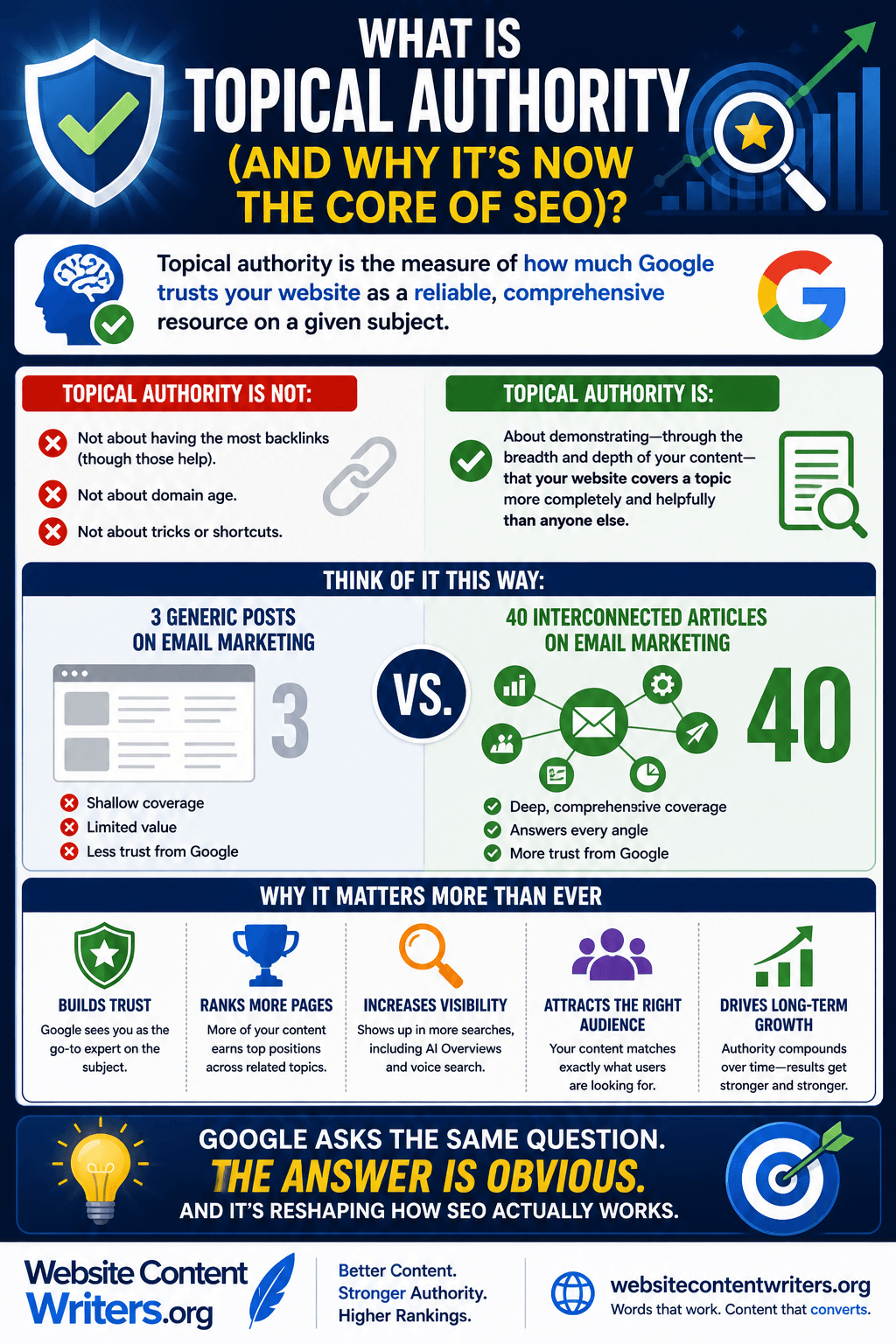
It’s not about having the most backlinks (though those help). It’s not about domain age. It’s about demonstrating — through the breadth and depth of your content — that your website covers a topic more completely and helpfully than anyone else.
Think of it this way: if you wanted to learn everything about email marketing, would you rather visit a website with 3 generic posts on the subject, or one with 40 interconnected articles covering strategy, automation, deliverability, copywriting, segmentation, A/B testing, and platform comparisons?
Google asks the same question. The answer is obvious — and it’s reshaping how SEO actually works.
How Google Actually Evaluates Expertise in 2025
Modern search engines use semantic understanding, not just keyword matching. Google’s systems analyze topics, relationships, and context. They look at:
-
- How deeply you cover a subject — Are there obvious gaps in your content? Are questions left unanswered?
- How your pages connect to each other — Does your internal linking architecture reflect a coherent topic map?
- Whether your content satisfies real user intent — Are visitors finding complete answers, or bouncing back to search?
- Consistency and freshness — Is your site actively growing its topical coverage over time?
A website publishing 30 tightly interconnected articles about “content marketing for SaaS companies” will almost always outperform a site with a single, even well-written post on the same subject. The depth signals authority. The connections signal organization. The consistency signals trust.
The Death of the Single-Article Strategy
Until around 2018–2020, you could rank with a single well-optimized article targeting the right keyword. Competition was lower, Google’s semantic understanding was less sophisticated, and volume was the game.
Those days are over. Today:
-
- Competition is dramatically higher across almost every content niche
- Google prefers depth over surface-level content — a core principle reinforced in every recent algorithm update
- Users expect complete answers — they want to land on a resource that fully addresses their question, not a teaser that leaves them searching again
To rank in 2025, you need to demonstrate that your site is a trusted resource on an entire topic — not just a single keyword variant. That demonstration happens through content clusters.
What Are Content Clusters? A Clear Definition
A content cluster is a deliberately organized group of pages that together provide comprehensive coverage of a single core topic.
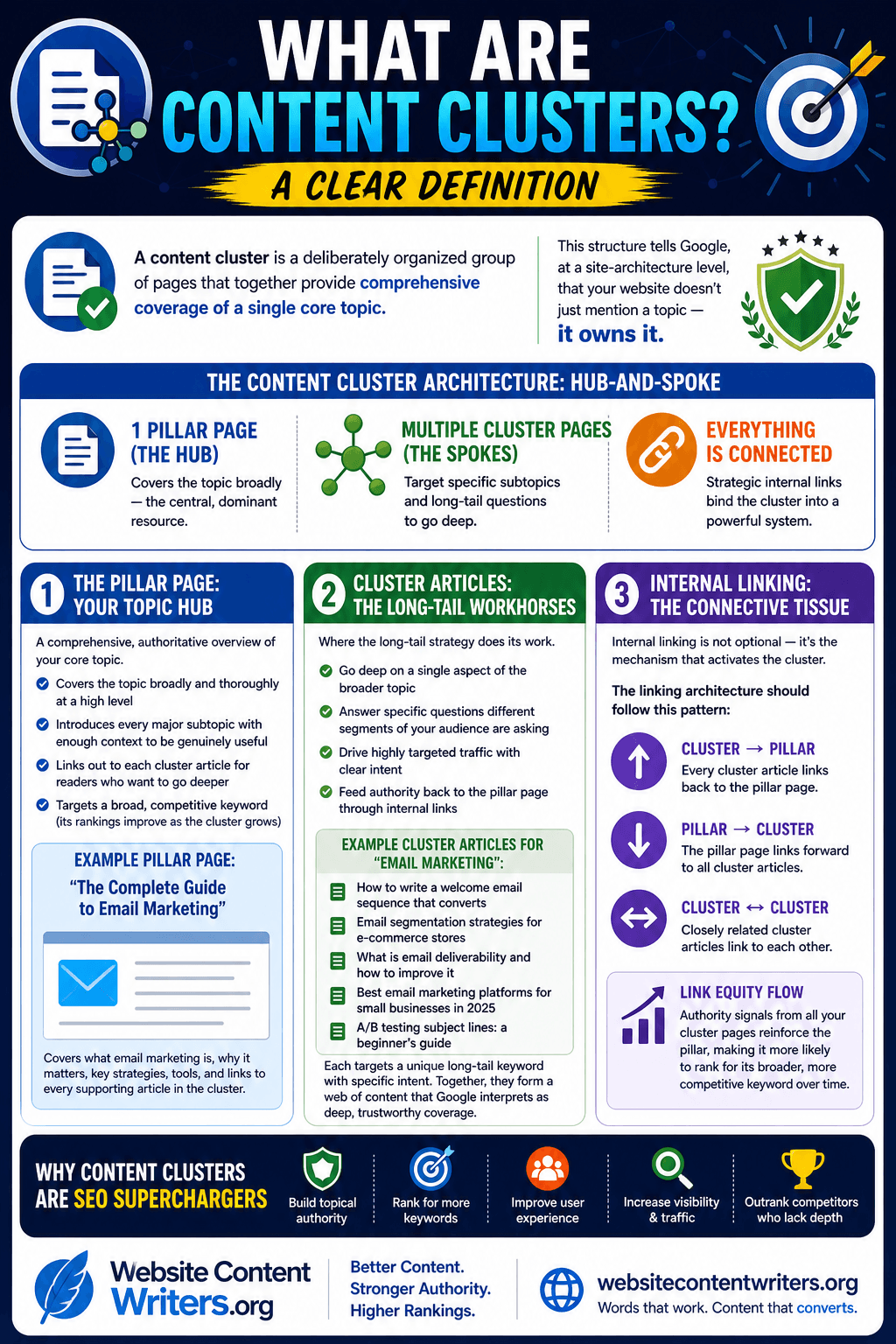
Instead of publishing random posts, you build around a hub-and-spoke architecture:
-
- One pillar page covers the topic broadly — it’s the hub
- Multiple cluster pages target specific subtopics and long-tail questions — these are the spokes
- Everything is connected through strategic internal links
This structure accomplishes something powerful: it tells Google, at a site-architecture level, that your website doesn’t just mention a topic — it owns it.
The Pillar Page: Your Topic Hub
The pillar page is a comprehensive, authoritative overview of your core topic. It doesn’t need to go extremely deep on every subtopic — that’s what cluster articles are for. But it does need to:
-
- Cover the topic broadly and thoroughly at a high level
- Introduce every major subtopic with enough context to be genuinely useful
- Link out to each cluster article for readers who want to go deeper
- Target a broad, competitive keyword (knowing that its rankings will improve as the cluster grows)
Example pillar page: “The Complete Guide to Email Marketing”
This page covers what email marketing is, why it matters, key strategies, tools, and links to every supporting article in the cluster.
Cluster Articles: The Long-Tail Workhorses
Cluster articles are where the long-tail strategy does its work. Each article targets a specific, narrow subtopic with its own distinct long-tail keyword. They:
-
- Go deep on a single aspect of the broader topic
- Answer specific questions that different segments of your audience are asking
- Drive highly targeted traffic with clear intent
- Feed authority back to the pillar page through internal links
Example cluster articles for “Email Marketing”:
-
- “How to write a welcome email sequence that converts”
- “Email segmentation strategies for e-commerce stores”
- “What is email deliverability and how to improve it”
- “Best email marketing platforms for small businesses in 2025”
- “A/B testing subject lines: a beginner’s guide”
Each of these targets a unique long-tail keyword with specific intent. Together, they form a web of content that Google interprets as deep, trustworthy coverage of the email marketing topic.
Internal Linking: The Connective Tissue
Internal linking is not optional — it’s the mechanism that activates the cluster. Without deliberate linking, your content cluster is just a collection of articles, not a system.
The linking architecture should follow this pattern:
-
- Cluster → Pillar: Every cluster article links back to the pillar page
- Pillar → Cluster: The pillar page links forward to all cluster articles
- Cluster ↔ Cluster: Closely related cluster articles link to each other
This creates what SEOs call “link equity flow” — the authority signals from all your cluster pages reinforce the pillar, making it more likely to rank for its broader, more competitive keyword over time.
What Are Long-Tail Keywords — And Why They’re Central to This Strategy?
Long-tail keywords are longer, more specific search queries that typically reflect a precise intent. They contrast with “head” or “short-tail” keywords, which are shorter and more general.
| Type | Example | Monthly Volume | Competition | Ranking Difficulty |
| Short-tail (head) | “email marketing” | 200,000+ | Very High | Very Hard |
| Mid-tail | “email marketing strategy” | 8,000–20,000 | High | Hard |
| Long-tail | “how to write a welcome email sequence for e-commerce” | 200–1,000 | Low | Easy–Moderate |
The numbers look intimidating at first — why target 300 searches a month instead of 200,000? The answer is in the math and the mechanics.
The Long-Tail Advantage: Five Reasons They Win
Here are five reasons why long-tail content clusters help a website rank easily:
-
- Lower Competition – Long-tail queries are often ignored by large, established websites that focus on high-volume head terms. This leaves a genuinely open lane for smaller sites to rank quickly without needing hundreds of backlinks.
- Precise User Intent – Someone searching “email marketing” could want anything — a tool, a definition, a course, a job. Someone searching “how to write a welcome email sequence for a SaaS product” knows exactly what they want. Your content can meet that intent precisely, which Google rewards.
- Higher Conversion Rates – Because long-tail searchers have specific intent, they convert at a significantly higher rate than broad-intent visitors. The traffic is smaller but dramatically more valuable.
- Faster Rankings – New or lower-authority sites can rank for well-chosen long-tail keywords in weeks, not months. This generates early traffic wins that build momentum, data, and some initial authority signals.
- Cumulative Coverage – Here’s the real magic: when you publish 15–25 cluster articles each targeting a different long-tail keyword in the same niche, the combined traffic and authority signals you generate often help your pillar page rank for the broad, competitive head term too — even though you never could have ranked for it directly.
Long-tail keywords are not a consolation prize. They’re the engine.
Why Long-Tail Content Clusters Are Especially Powerful in 2026
This is where the two concepts fuse into something genuinely transformative.
On their own:
-
- Long-tail keywords give you achievable rankings but limited scale
- Content clusters give you authority but require substantial content investment
Together, long-tail content clusters give you a system that is both achievable at any site size and scalable to any level of ambition.
Here’s what you create when you combine them:
Complete Topic Coverage
Instead of answering one question, you answer all the relevant questions — the broad ones on the pillar, the specific ones in each cluster article. This is exactly what Google’s semantic evaluation is looking for.
Multiple Simultaneous Rankings
Each cluster article ranks independently for its long-tail keyword. So instead of betting everything on one article to rank for one keyword, you’re running 15–25 ranking campaigns simultaneously. Some will outperform expectations. All of them build toward the whole.
Compounding Authority Over Time
Every new cluster article you publish strengthens the entire cluster. The pillar page gets stronger. Existing cluster articles get more internal link equity. Your topical authority score in Google’s eyes grows. The effect is compounding — not linear.
Faster Indexing and Crawlability
A well-linked content cluster gives Google’s crawlers a clear path through your site. When you publish a new cluster article and link it from the pillar and related articles, Google finds and indexes it quickly. Your site looks active, organized, and expansive.
Barrier to Competition
Once you’ve published a complete cluster of 20 articles on a topic, a competitor can’t dislodge you with a single great post. They’d need to rebuild your entire cluster. That’s a significant moat.
Step-by-Step: How to Build Long-Tail Content Clusters
Here is the exact process you can follow for any niche, from scratch.
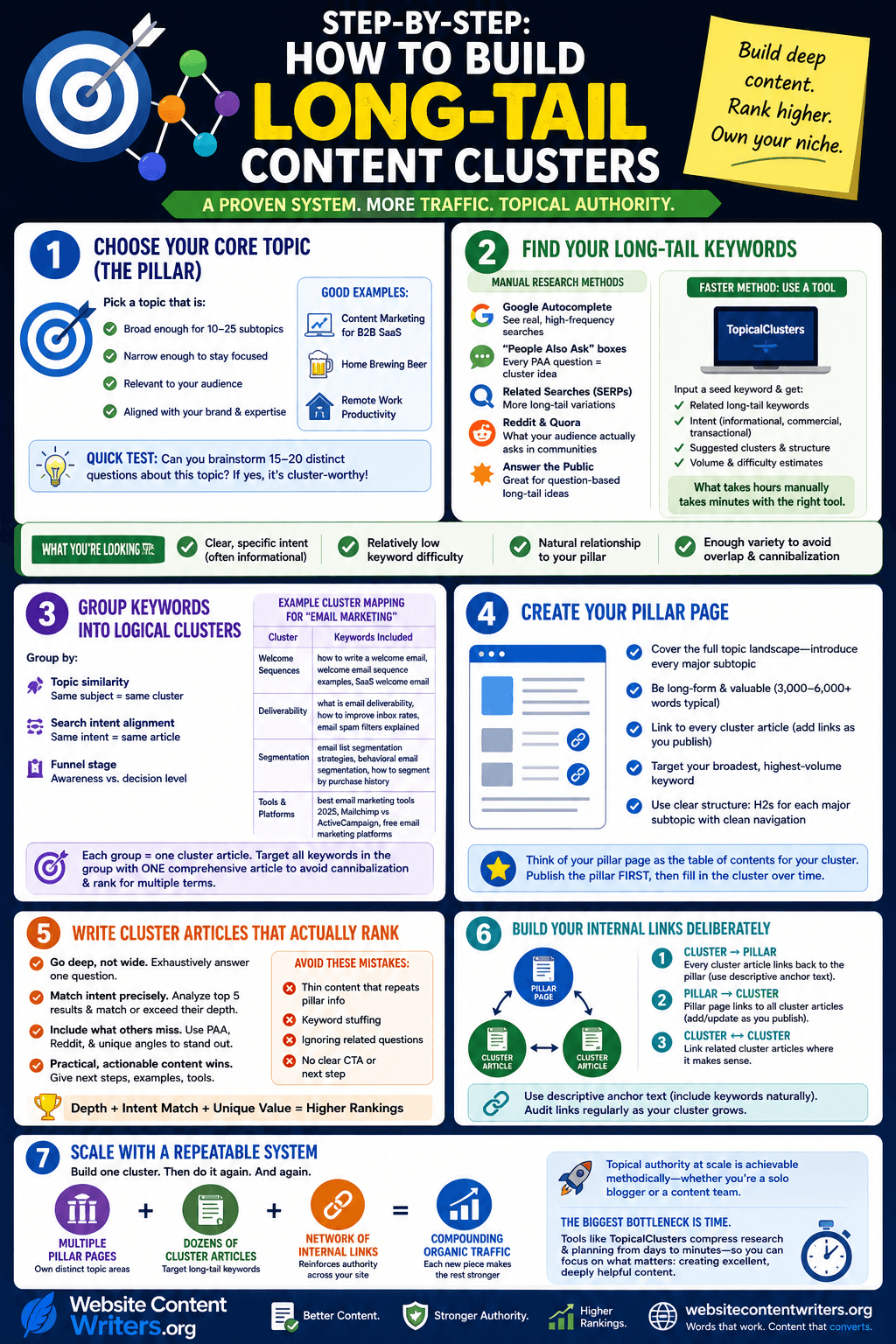
Step 1: Choose Your Core Topic (The Pillar)
Start with a subject that is:
-
-
-
- Broad enough to support 10–25 subtopics and cluster articles
- Narrow enough to stay focused and avoid sprawl
- Relevant to your audience and aligned with what you actually want to be known for
-
-
Good core topic examples:
-
-
-
- Content Marketing for B2B SaaS (niche, own-able)
- Home Brewing Beer (passionate community, many subtopics)
- Remote Work Productivity (broad but focusable)
-
-
Avoid topics that are so broad (e.g., “marketing”) that you’d need thousands of articles to cover them meaningfully, or so narrow (e.g., “email subject line length”) that you’d run out of subtopics after three articles.
Quick validation test: Can you brainstorm at least 15–20 distinct questions someone might ask about this topic? If yes, it’s cluster-worthy.
Step 2: Find Your Long-Tail Keywords
With your core topic identified, the next step is building a keyword map.
Manual research methods:
-
-
-
- Google Autocomplete — Start typing your core topic into Google and see what it suggests. These suggestions reflect real, high-frequency searches
- “People Also Ask” boxes — Every PAA question is a potential cluster article topic
- Related Searches (bottom of SERPs) — More long-tail variations you can explore
- Reddit and Quora — What questions does your audience actually ask in communities? These often surface long-tail angles keyword tools miss
- Answer the Public — Excellent for generating question-based long-tail variants
-
-
Faster method — using a topical cluster tool: Tools like TopicalClusters automate much of this process. You input a seed keyword or core topic, and the tool generates:
-
-
-
- A full list of related long-tail keyword variations
- Intent classification for each keyword (informational, commercial, transactional)
- Suggested groupings and cluster structures
- Volume and difficulty estimates
-
-
What takes hours manually takes minutes with the right tool — and the output is more structured and complete.
What you’re looking for:
-
-
-
- Keywords with clear, specific intent (usually informational for cluster articles)
- Relatively low keyword difficulty (especially for newer sites)
- A natural relationship to your pillar topic
- Enough variety to avoid overlap or cannibalization between articles
-
-
Step 3: Group Keywords Into Logical Clusters
Raw keywords aren’t a content strategy. Organized keyword clusters are.
Group your keywords by:
-
-
-
- Topic similarity — Which keywords are clearly about the same underlying subject?
- Search intent alignment — Keywords with the same intent (e.g., “how to” questions) belong together and may even share a single article
- Funnel stage — Awareness-level questions vs. decision-level comparisons serve different audiences and purposes
-
-
Example cluster mapping for “Email Marketing”:
| Cluster | Keywords Included |
| Welcome Sequences | how to write a welcome email, welcome email sequence examples, SaaS welcome email |
| Deliverability | what is email deliverability, how to improve inbox rates, email spam filters explained |
| Segmentation | email list segmentation strategies, behavioral email segmentation, how to segment by purchase history |
| Tools & Platforms | best email marketing tools 2025, Mailchimp vs ActiveCampaign, free email marketing platforms |
Each group becomes one cluster article. The keywords within a group are all targeted by that single piece of content — you don’t write a separate article for every minor keyword variation.
This prevents keyword cannibalization (your own pages competing against each other) and creates articles that are comprehensive enough to rank for multiple related terms simultaneously.
Step 4: Create Your Pillar Page
Your pillar page is the anchor of everything. Build it to:
-
-
-
- Cover the full topic landscape — introduce every major subtopic
- Be genuinely long-form and valuable — pillar pages typically run 3,000–6,000+ words
- Link to every cluster article you plan to publish (even before they’re live, you can add links as you publish)
- Target your broadest, highest-volume keyword — knowing its rankings will improve as the cluster fills in
- Use clear structure — H2s for each major subtopic section, with clean navigation
-
-
Think of your pillar page as the table of contents for your entire cluster. Someone reading it should understand the full landscape of the topic and know exactly where to go to learn more about any specific aspect.
One important note: don’t wait until all your cluster articles are written to publish the pillar. Publish the pillar first, then systematically fill in the cluster over time.
Step 5: Write Cluster Articles That Actually Rank
Each cluster article targets one specific long-tail keyword group and one aspect of the broader topic. To write cluster articles that rank:
Go deep, not wide. A 1,500-word article that exhaustively answers one specific question will outperform a 3,000-word article that touches on ten questions shallowly. Depth signals expertise.
Match intent precisely. Before writing, search your target keyword and analyze the top 5 results. What format are they? (Tutorial? List? Definition?) What specific questions do they answer? Your article needs to match or exceed the depth and intent-alignment of what’s already ranking.
Include what others miss. Look at the “People Also Ask” questions for your keyword. Look at Reddit threads on the topic. Find the angles and specifics that existing articles skip — and cover them thoroughly. This is how you outrank established sites with less domain authority.
Practical, actionable content wins. Every cluster article should leave the reader with clear next steps, specific examples, or tools they can apply immediately. Content that creates genuine value gets shared, linked to, and bookmarked — all of which support rankings.
Avoid these common mistakes:
-
-
-
- Thin content that repeats what the pillar page already covered
- Keyword stuffing — targeting your keyword phrase excessively rather than naturally
- Ignoring related questions in favor of the primary keyword only
- Publishing without a clear call to action or next step
-
-
Step 6: Build Your Internal Links Deliberately
After each article is published, the internal linking work begins. Follow this structure:
-
-
-
- From the new cluster article → Pillar page (always, with descriptive anchor text like “email marketing strategy” not “click here”)
- From the Pillar page → New cluster article (add or update the link)
- From related cluster articles → New cluster article (wherever a natural contextual mention fits)
-
-
Descriptive anchor text matters. Instead of linking with “learn more,” use anchor text that includes your target keyword or a natural variation. This signals to Google what the linked page is about.
Audit your internal links regularly. As your cluster grows, there will be more opportunities to cross-link articles in ways that strengthen the whole structure.
Step 7: Scale With a Repeatable System
Once you’ve built one complete cluster, you have a template. The process works for every topic area you want to expand into.
Over time, a multi-cluster strategy creates:
-
-
-
- Multiple pillar pages — each owning a distinct topic area
- Dozens of cluster articles — each ranking for its own long-tail keyword
- A network of internal links — reinforcing authority across your entire site
- Compounding organic traffic — each new piece strengthening what came before
-
-
This is what topical authority at scale looks like. And it’s achievable methodically, whether you’re a solo blogger or a content team of ten.
The biggest bottleneck in this process is time — specifically, the time it takes to research keyword clusters, plan content, and execute consistently. This is precisely where tools like TopicalClusters become genuinely valuable: they compress the research and planning phase from days to minutes, so you can spend your time on what actually creates value — writing excellent, deeply helpful content.
A Real Long-Tail Content Cluster: Full Example
Let’s make this concrete with a complete example.
Core Topic / Pillar Page: Content Marketing for Freelancers
Long-Tail Cluster Articles:
-
- How to create a content portfolio with no experience (target: “content portfolio beginner”)
- Best content marketing tools for freelancers on a budget (target: “content marketing tools freelancer”)
- How to find content writing clients on LinkedIn (target: “find content clients LinkedIn”)
- Content marketing rates: what to charge as a freelancer in 2025 (target: “content marketing freelancer rates”)
- How to write a content strategy proposal for a client (target: “content strategy proposal template”)
- SEO basics every freelance content marketer needs to know (target: “SEO for freelance content writers”)
- How to build a personal brand as a content marketer (target: “personal brand content marketing freelancer”)
- Common content marketing mistakes freelancers make (target: “content marketing mistakes freelancer”)
- How to use content repurposing to work smarter as a freelancer (target: “content repurposing strategy freelancer”)
- Content marketing niches with the highest-paying clients (target: “content marketing niches high paying”)
Each article targets a different long-tail keyword with distinct intent. Each links back to the pillar. The pillar links to all ten. As you publish, the cluster becomes a comprehensive resource hub for freelance content marketers — and Google sees your site as the authority on that topic.
Notice that none of these keywords — “content portfolio beginner,” “find content clients LinkedIn,” “content strategy proposal template” — are keywords a Forbes or HubSpot would bother writing a dedicated article for. That’s the long-tail opportunity. You’re not competing with them. You’re winning in the spaces they’ve ignored.
Common Mistakes That Undermine Content Clusters
Even with a sound strategy, these execution mistakes can cost you results:
-
- Writing random posts and calling them a cluster – A cluster only functions as a cluster if every article is deliberately interconnected. Publishing ten loosely related articles without strong internal links is not a cluster — it’s a blog with a theme.
- Neglecting internal links after publishing – Many writers publish an article and never update it again. But as your cluster grows, you should regularly revisit older articles to add links to newer ones. This keeps the whole cluster active and interconnected.
- Targeting head keywords on cluster articles – Cluster articles should target specific long-tail keywords. If you’re trying to rank a cluster article for “email marketing” (a head keyword), you’re competing directly with your pillar page and with massive competitors. Keep cluster articles focused on specific, answerable questions.
- Creating thin content to publish faster – Volume doesn’t beat depth. One comprehensive, genuinely useful cluster article is worth ten thin pieces that barely answer the question. Google is increasingly good at evaluating real quality.
- Not researching intent before writing – Every keyword has a dominant intent. If searchers want a quick answer and you write a 4,000-word tutorial, you’ll lose to a crisp 800-word explanation — even if yours is “better.” Always check the SERPs and match the format that’s already winning.
- Treating the pillar page as the only priority – Many site owners obsess over the pillar page and rush through cluster articles. In reality, the cluster articles are doing most of the early ranking work. Give them the same quality attention as the pillar.
How Long Does It Take to Build Topical Authority?
One of the most common questions people ask is: how long does it actually take to build topical authority?
The honest answer is — it depends on your content strategy, but most websites start seeing measurable results within 4 to 12 weeks when using long-tail content clusters correctly.
The reason is simple: topical authority isn’t built from a single article. It’s built through consistent publishing across a structured cluster of related topics that signals depth and expertise to Google.
A Realistic Publishing Timeline
Here’s what a typical timeline looks like when building topical authority with long-tail content clusters:
-
- Weeks 1–2:
Publish your core pillar page and 3–5 supporting cluster articles. At this stage, Google begins crawling and understanding your site structure. - Weeks 3–6:
Continue adding cluster content (2–3 articles per week). You may start seeing impressions in Google Search Console as your topical relevance grows. - Weeks 6–12:
Your content clusters begin to connect and reinforce each other. Rankings improve, and some pages may start reaching page one for long-tail keywords. - 3+ Months:
With consistent publishing and internal linking, your site builds strong topical authority, making it easier to rank for more competitive keywords.
- Weeks 1–2:
Why Most Websites Get This Wrong
Many site owners publish randomly and expect fast results. But without a clear publishing cadence and cluster structure, Google doesn’t see enough depth to rank your content confidently.
By focusing on long-tail content clusters, you accelerate this process. Instead of waiting months for a single article to rank, you create a system where multiple related pages work together — helping your entire site rank faster and more consistently.
Building real topical authority is a medium-term investment. Here’s a realistic timeline:
| Phase | Timeline | What to Expect |
| Foundation | Months 1–2 | Publish pillar + first 5–8 cluster articles; little traffic yet |
| Early traction | Months 3–4 | Long-tail cluster articles start ranking; traffic begins growing |
| Momentum | Months 5–6 | Visible traffic growth; pillar page begins improving in rankings |
| Authority | Months 7–12 | Cluster reinforces itself; pillar ranking for competitive terms |
Several factors accelerate or slow this timeline:
-
- Content quality — depth and genuine usefulness matter enormously
- Publishing consistency — irregular publishing slows momentum
- Internal linking — clusters with poor linking take longer to activate
- Niche competition — some topics have thinner competition and respond faster
- Site age and existing authority — newer sites face a longer runway
The good news: for most long-tail content clusters in moderate-competition niches, you can see meaningful ranking and traffic results within 3–4 months of consistent publishing. That’s significantly faster than trying to compete for head keywords with a new site.
Tools to Build Long-Tail Content Clusters More Efficiently
You don’t need expensive enterprise software to execute this strategy, but the right tools make a significant difference:
For keyword research:
-
- Google Search (autocomplete, PAA, related searches) — free and often underrated
- Google Keyword Planner — free, useful for volume estimates
- Ahrefs / Semrush — paid, best-in-class for keyword difficulty and competitive analysis
For cluster planning and organization:
-
- TopicalClusters — purpose-built for generating keyword cluster structures, mapping pillar and supporting content, and organizing your entire content strategy around topical authority
- Notion or Airtable — useful for manually tracking your cluster map
For SERP and intent analysis:
-
- Google Search (just search your keywords and read what ranks)
- SurferSEO — paid, good for content optimization
The most time-intensive parts of this process — keyword research, clustering, and content mapping — are where automation has the biggest impact. TopicalClusters is designed specifically to eliminate those bottlenecks, so you can move from strategy to execution without the weeks of spreadsheet work.
Final Thought: Stop Building Content. Start Building Systems.
Here’s the mindset shift that changes everything:
Most bloggers and content teams think in terms of articles. They ask, “What should I write next?”
The sites that consistently win in organic search think in terms of systems. They ask, “Which cluster should we build next? Which subtopics are we missing? How does this article connect to what we’ve already published?”
When you adopt the long-tail content cluster approach, you stop publishing random content and start building an interconnected knowledge architecture. Every article you write makes every other article stronger. Your authority compounds. Your traffic compounds. The work you do today pays dividends for years.
That’s what topical authority actually is — not a trick or a tactic, but a structural advantage that gets harder and harder for competitors to dismantle once you’ve built it.
Ready to start building?
If you want to skip the manual keyword research and cluster mapping and jump straight to publishing, TopicalClusters will generate your entire cluster structure — keywords, subtopics, pillar framework, and content map — in minutes.
Build your first long-tail content cluster
Frequently Asked Questions
What is a long-tail content cluster? A long-tail content cluster is a group of SEO articles organized around a central topic, where each supporting article targets a specific long-tail keyword (a narrow, lower-competition search query). Together, they form a comprehensive content system that builds topical authority and generates traffic across many keyword variations simultaneously.
How many articles should a content cluster have? Most effective content clusters contain 8–20 supporting articles around one pillar page, though some comprehensive clusters in competitive niches run to 30+ pieces. The right number depends on how many distinct long-tail subtopics exist within your core topic. Start with 8–10 and expand as you identify more keyword opportunities.
Why are long-tail keywords better for building topical authority? Long-tail keywords are less competitive, more intent-specific, and far more numerous than broad head keywords. This means you can rank for them more quickly (generating early traffic and authority signals), cover a topic more completely (since there are dozens or hundreds of long-tail variations per topic), and build a cluster structure that eventually elevates your pillar page into more competitive rankings.
Can a new or small website build topical authority? Absolutely — and in many ways, the long-tail content cluster strategy is more advantageous for smaller sites than for large ones. Large sites tend to focus on high-volume head keywords, leaving long-tail opportunities open. A small, focused site that dominates a content cluster around a specific topic can outrank much larger general sites for those specific queries.
How do I know if my content cluster is working? Track rankings for each cluster article’s target keyword, watch for improvements in the pillar page’s position for its broader keyword, and monitor organic traffic over time. Typically, individual cluster articles begin ranking within 6–12 weeks; the pillar page’s rankings improve over 3–6 months as the cluster fills in. Google Search Console is your best free tool for tracking this progress.
How is a content cluster different from just having a blog? A blog is a collection of articles. A content cluster is a deliberately structured system of articles, connected through internal links, built around a specific topic map, and designed to signal topical authority to search engines. The difference is strategy and structure — not just content volume.